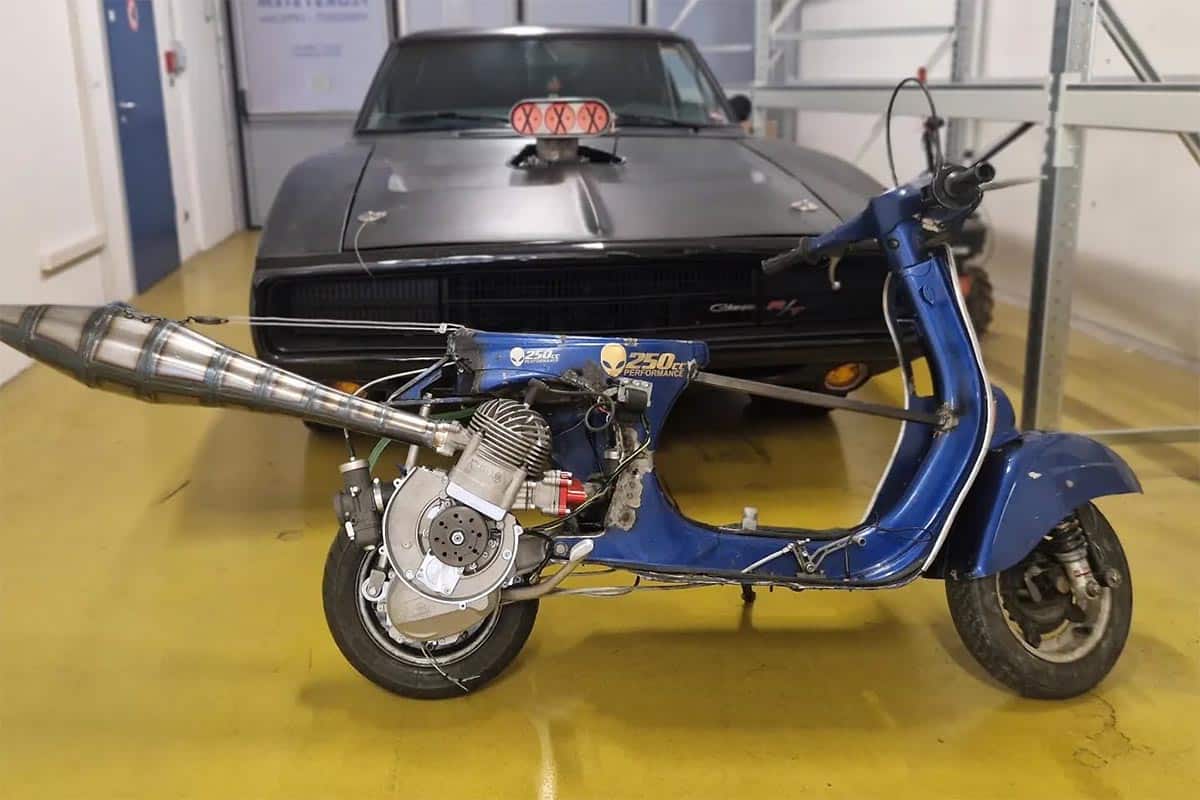
Some of the characteristic features of Vespa are the style, the finishes, the comfort, but of course among them are not the exorbitant power figures or the scary top speeds either.
But that doesn’t mean that, from time to time, we come across a project that throws all those hallmarks out the window and ends up giving way to a preparation that makes your hair stand on end. This is the case of the so-called Project 407, which with a completely renewed mechanical base has managed to exceed 100 HP on a test bench, as can be seen in the video.
Behind this project is Egig Performance, a workshop founded in 2017 by Erich Oberpertinger in the Alto Adige region (Italy). Its activity revolves around the development of components and complete engines for two-stroke Vespa, especially the so-called classic “Smallframe”, although this project clearly goes one step beyond its usual production.

The starting point is a 407 cc single-cylinder engine, with forced air cooling, which has been in development for more than four years. In the first tests carried out in 2026, the set has reached figures of between 103 and 104 HP at around 11,000 rpm, with a torque close to 75 Nm.
This Vespa prepared by Egig Performance has more than 100 HP… but a meter and a half exhaust
Beyond the numbers, which the truth is that they arouse both curiosity and fear, what draws attention is how it has been achieved. The engine uses unusual solutions in this type of preparation, such as a crankshaft with a high tungsten alloy, forged connecting rod or a completely redesigned crankcase, although maintaining relatively compact dimensions.
Power is provided by two 42 mm flat gate carburetors, derived from the two-stroke era in the Motorcycle World Championship, while the exhaust system, which is quite striking because it is approximately one and a half meters long, plays a key role in maintaining performance above 100 HP.
To manage the power, the four-speed manual transmission has been reinforced, going from a three-disc clutch to a six-disc one. In addition, structural reinforcements have been introduced in the rear area to avoid deformations of the body during intense accelerations. And these features were never considered when the original Vespa project was in the hands of Piaggio designers.
The figures used by the project point, in theory, to a maximum speed close to 200 km/h. However, it must be taken into account that the chassis and brake system are still based on a Vespa from the seventies, so you would have to be very brave (or reckless) to reach them.
In any case, it is not a product designed for the general public. A very limited series of five complete units is planned, with a price of around 10,000 euros. An amount that does not seem exaggerated for such a different and exclusive preparation.