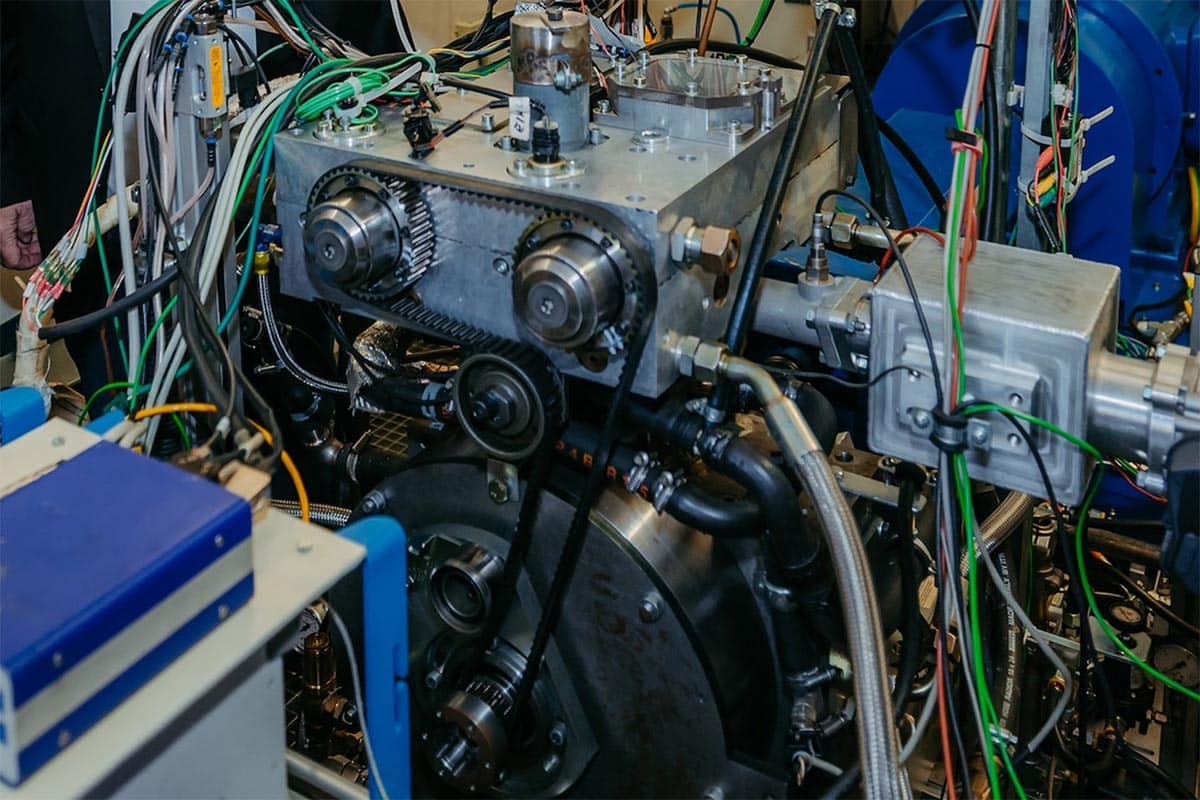
The hydrogen engine is one of those objectives that the industry and researchers are pursuing but that, at least so far, they are not able to refine enough to make the accounts add up and be a tangible option. That does not mean that they are not trying and, according to their own research at the Otto-von-Guericke University of Magdeburg in Germany, they have found a path that may be interesting.
The development, as reported by MCN, focuses on a hydrogen combustion engine that introduces a key difference compared to conventional approaches. The basis of the system, which is still a thermal engine, does not change so much as the way in which the gases are managed during the process.
According to the researchers, the prototype used, a single-cylinder test engine, has already exceeded 60% efficiency on the bench. To put it in context, current gasoline engines usually move between 30% and 40%, while hydrogen engines, in their most conventional version, are somewhat above, but far from that figure. Reaching that level brings it closer to what fuel cells can offer, although through a different technical path.

This hydrogen engine integrates a system that reuses gases
The key to the concept is its closed-loop operation. Unlike a traditional engine, which draws in air, mixes it with fuel and expels exhaust gases, this system keeps most of the mixture within the cycle itself.
Combustion is carried out with hydrogen, oxygen and argon, the latter as an inert gas that helps control the reaction. After each cycle, the gases are cooled and reused, which significantly reduces exhaust emissions. Under normal conditions, the main byproduct of hydrogen combustion is water vapor.
This approach is what allows us to speak of a system practically free of emissions in use, at least with regard to what comes out of the exhaust. Another different issue is everything that is involved in the production and transportation of hydrogen itself.
For now, yes, this development is far from reaching production and even less so to motorcycles. Researchers place its possible application in areas such as heavy machinery, maritime transport or long-distance trucks, where the limitations of batteries continue to be more evident.
Still, the project is not without problems. The amount of hydrogen that can be injected in each cycle is limited and with use, carbon dioxide buildup may occur within the system due to combustion of the lubricating oil. These are aspects that affect performance and still require development.
Beyond the engine itself, hydrogen still has a clear obstacle: its storage. Although it has a high energy density per weight, it needs very high pressures or extremely low temperatures to be stored in useful quantities, something especially complex in motorcycles. In that sense, even with improvements in efficiency, the basic problem does not disappear. The amount of fuel needed may be reduced, but it does not eliminate the limitations associated with its storage and infrastructure.