When Liberty took over MotoGP, we were all afraid that they would try to clone what they had done in F1 and how well it had turned out. Some of us even remember at that moment that motorcycling and motorsport have great differences. But Liberty has been relentless, day by day it is “carrying” the essence of the Motorcycle World Championship, which is much more than MotoGP, and is taking its final steps.
The search for new audiences artificially instead of returning to what really worked, which was having races on television and open air (even if they were delayed), are ending up removing the soul from what was once a championship with logic, scale and promotional work. Although it was always more humble than F1, it managed to get people talking about motorcycles on Monday mornings while having coffee at the bar.

But for the new owners of the rights to the championship, it seems that the goal is to make a clone of F1 but with two wheels, and that is why they are changing the format of the weekend again. The curious thing about this change is that the drivers were openly complaining about the previous format and, suddenly, another extra qualifying session arrives.
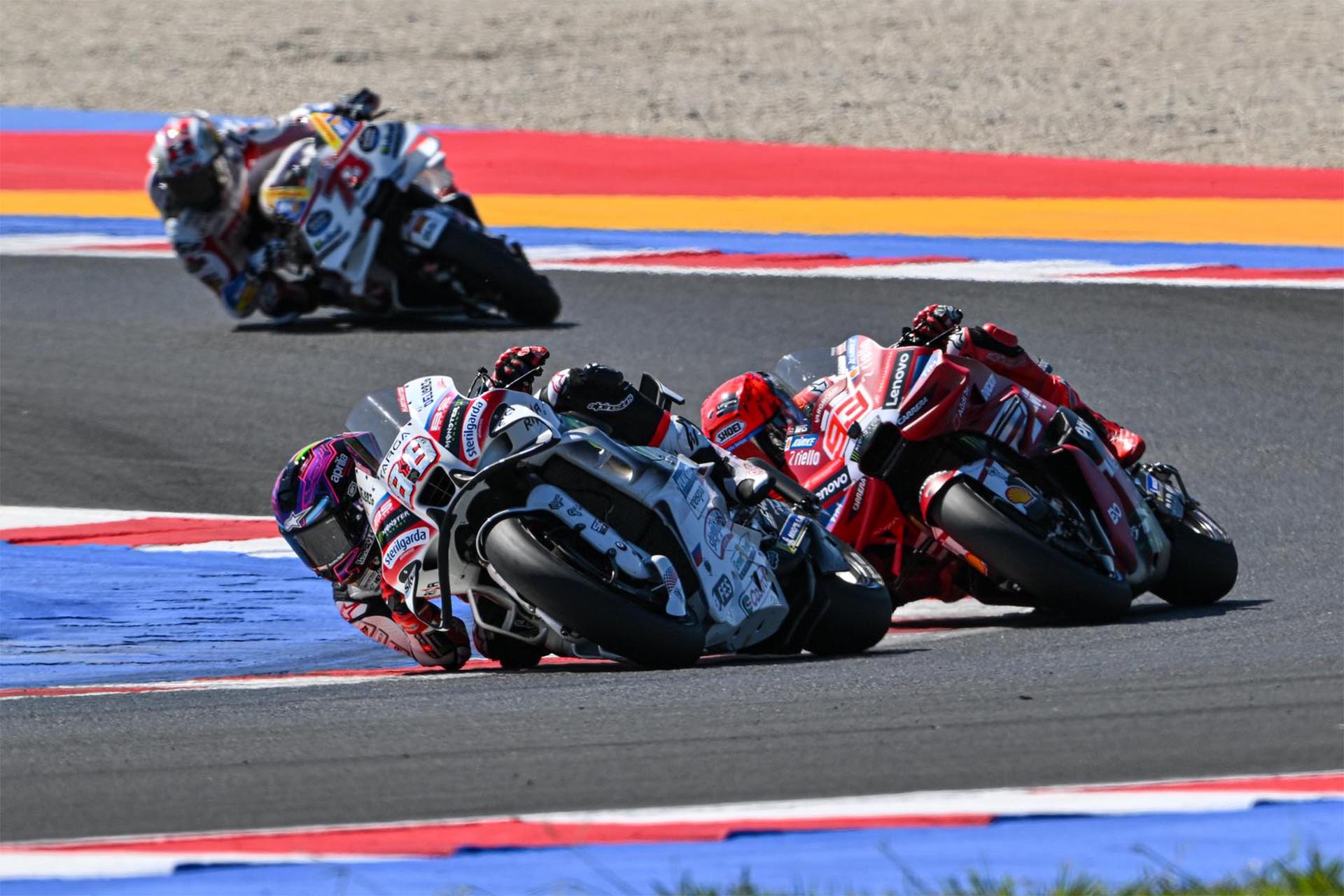
The new MotoGP format will give greater intensity and will be more demanding and risky for the riders
Because the new format for MotoGP, which will come into force from next year, is just that. Until now the grids for Saturday and Sunday were the same and were decided in the qualifier. Starting in 2027 this will not be the case and each race will have its own grid.
Obviously the new format could not bring more hours of motorcycle time on the track due to costs, so the restructuring changes the duration of the sessions and eliminates the warm-up. And the latter is especially curious just after, due to the problems in Motegi, its duration had to be doubled.
In any case, now on Friday there will be three sessions. An FP1 of 45 minutes, an FP2 of 30 and then a qualifier to define the Sprint grid that will last 15 minutes and in which all the drivers will participate at the same time. Of course, although there will be three sessions, the motorcycle time on the track drops to 90 minutes in total, when until now we had 105 between FP1 and Practice.
On Saturday the situation also changes with a FP3 of only 20 minutes (previously FP3 was 30) and the usual Q1 and Q2 but with a peculiarity. All drivers will take part in Q1 and the top 12 will fight for pole in Q2. The Sprint will arrive in the afternoon.
And on Sunday there are also changes. As we said, the warm-up is over, although to compensate, the pit lane will be kept open an extra 10 minutes before the race so that several laps can be done, as happens in F1, but passing through the pit lane instead of the straight.
A series of changes that, according to MotoGP’s own statement, “It combines an even greater spectacle for fans and new incentives in each session with balanced track time for drivers, teams and factories.”
The reality is that it will demand even more from drivers who will have a little less time on the track, but with much greater intensity and risk.