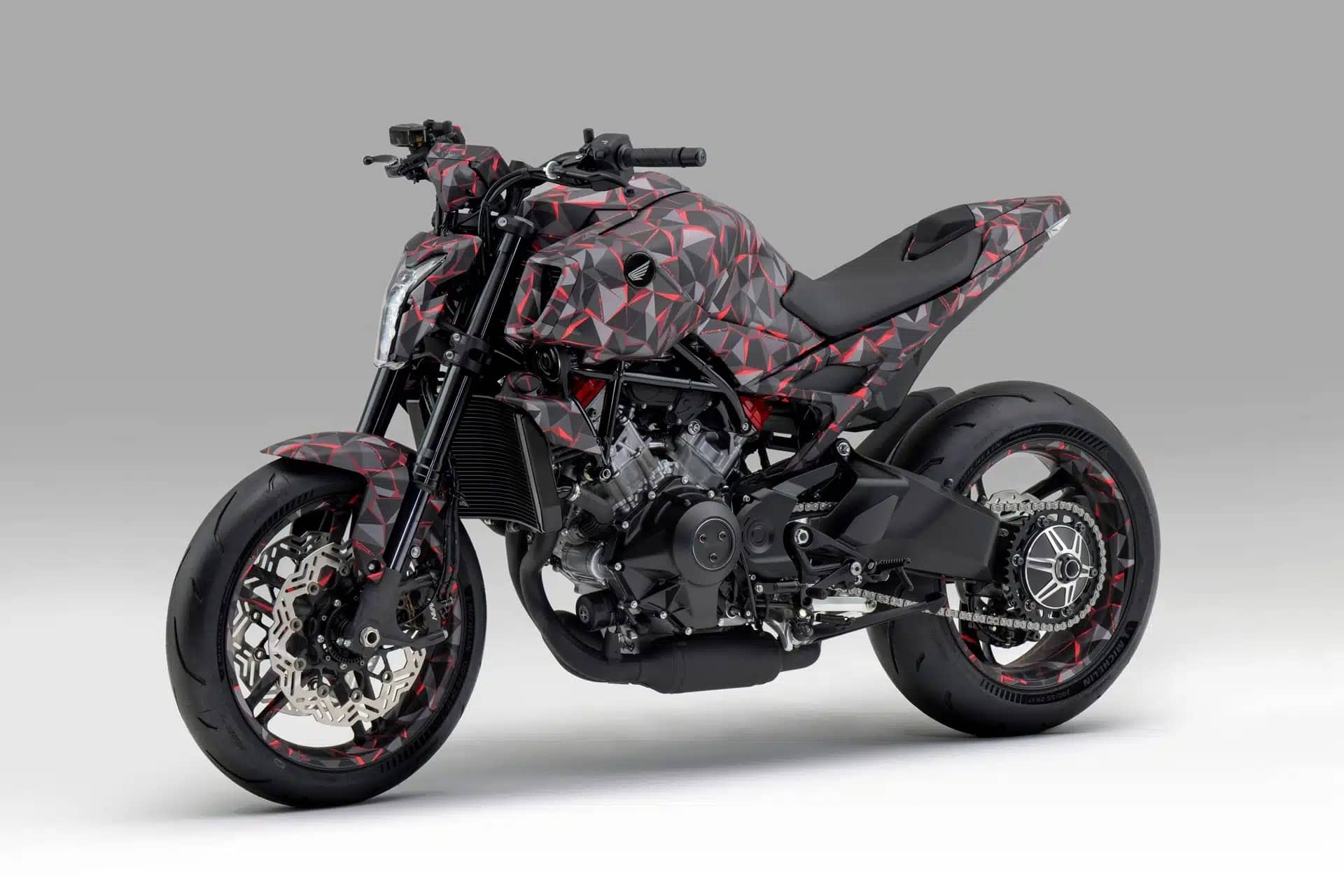
The Honda V3R 900 E-Compressor Prototype is one of those bikes that makes you stop and look twice. Not only because of its sharp aesthetics, its asymmetrical fairings or the mystery that still surrounds its definitive technical specifications, but because behind it there is a much deeper idea: redefining what a street sports motorcycle can be like in an era marked by emissions regulations, efficiency and the need to continue exciting the rider.
Honda presented the V3R 900 E-Compressor Prototype at EICMA 2025 as a direct evolution of the V3 engine with electric compressor that it had already shown at EICMA 2024. The brand confirms a displacement of 900 cc, a 75-degree V3 architecture, liquid cooling and an electronically controlled compressor, in addition to making it clear that it will continue its development with mass production as a goal.
1. An electric compressor that changes the rules of the game
The first big key is in the supercharging system. Honda does not use a turbocharger powered by exhaust gases, nor a traditional mechanical compressor driven by the engine. The V3R uses an electronically controlled compressor, capable of compressing the intake air regardless of the engine speed.
This is crucial. On a motorcycle, where throttle control, traction and immediate response are much more sensitive than in a car, eliminating the typical turbo lag can make a huge difference. The idea is not only to get more power, but to offer thrust from below, a more direct response and a much more modulable delivery.
2. Performance of 1,200 with only 900 cc

Honda has not yet revealed the final power. What it has officially communicated is that it is working to ensure that this 900 cc engine offers performance comparable to that of a 1,200 cc engine, while also maintaining good environmental efficiency.
Here is one of the most interesting reads of the project. The V3R could offer the thrust of a large displacement maxinaked, but with a more compact, lighter and narrower block. This would allow the agility of a medium-high displacement motorcycle to be preserved, but with much greater punch in the low and medium ranges.
Therefore, rather than obsessing over whether it will end up declaring 150, 160 or 170 HP, the important thing will be the torque curve. If Honda keeps its promise, the V3R could have a full delivery from very low, without needing to stretch each gear to the top of the rev counter.
3. A V3 engine that is not a free rarity
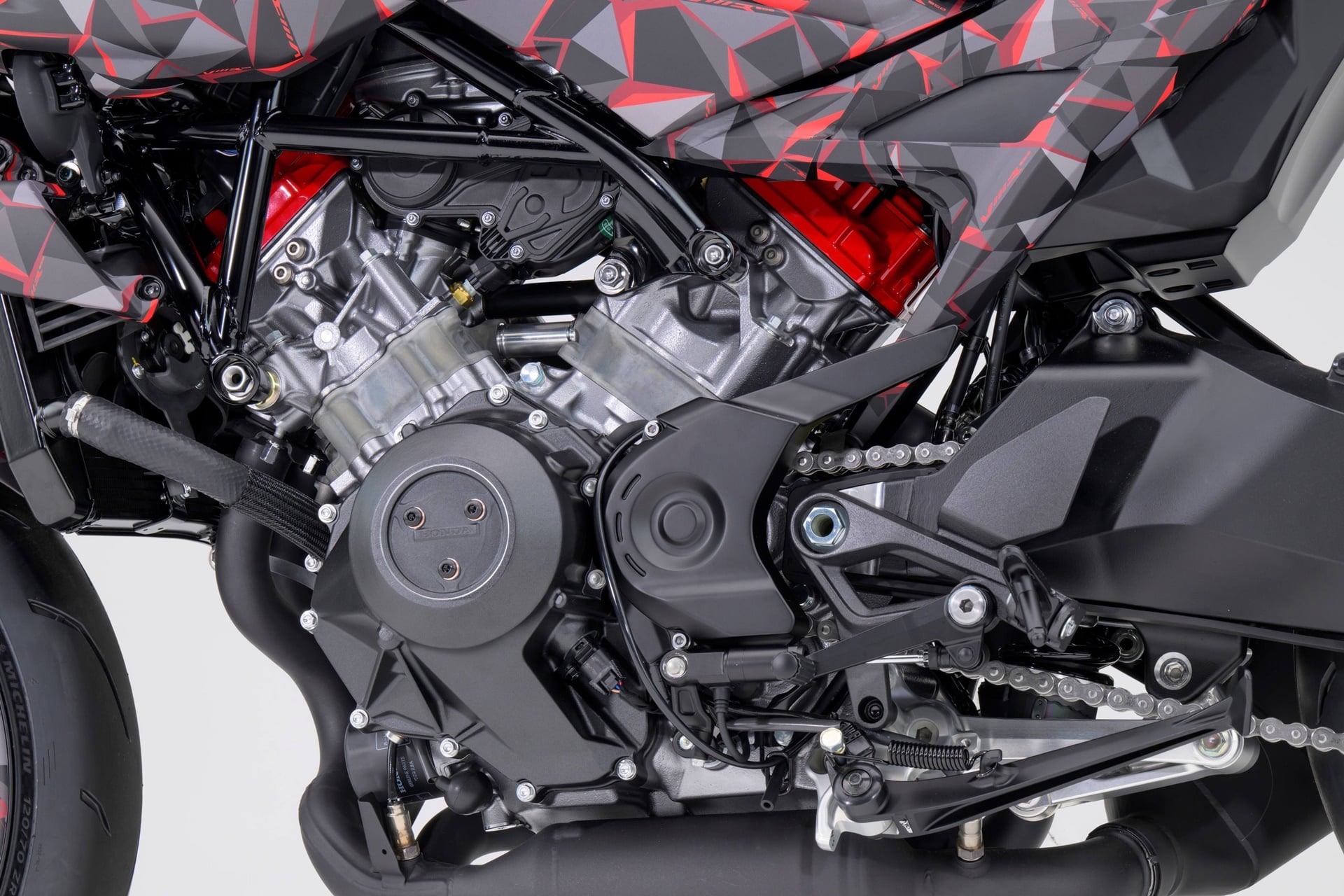
The V3 architecture is another of the great keys. Honda has chosen a 75-degree V-shaped three-cylinder engine, a very unusual configuration in modern production, but one that makes technical sense. Compared to an inline four-cylinder, a V3 allows for reduced width, concentrated masses and gives engineers more freedom to place auxiliary elements within the chassis.
Honda itself highlighted already in 2024 that this engine sought extremely compact dimensions in both length and width. In addition, the 75-degree V design leaves room to integrate the electric compressor in a favorable position, without increasing the overall volume of the assembly. The direct consequence can be a narrower motorcycle, easier to move between curves and with a cleaner front silhouette.
4. A supercharged Honda, but not Kawasaki H2 style
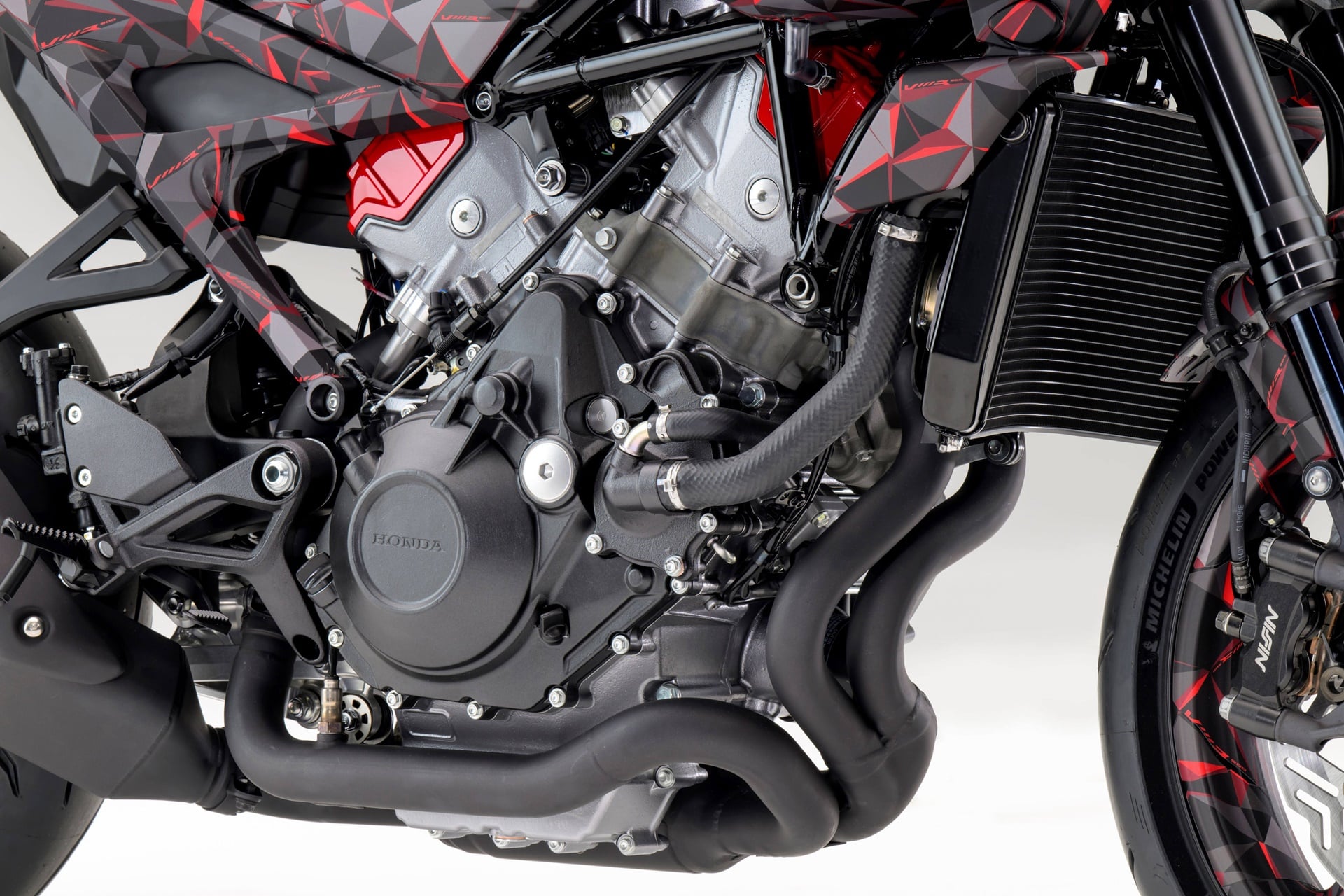
It is inevitable to compare this V3R with the Kawasaki H2, the great modern references of supercharged motorcycles. Kawasaki uses an internally developed compressor and on the Ninja H2R it declares extreme figures: 310 HP, or 326 HP with Ram Air, in addition to 165 Nm of torque.
But Honda’s approach seems different. The V3R is not born as a wild track hypersport, but as a motorcycle that seeks to integrate supercharging into a more usable riding experience. Honda expresses it with the “Non-Rail Roller Coaster” concept, a kind of roller coaster without rails, combining guaranteed excitement with a feeling of safety.
That phrase summarizes very well the character that Honda wants to achieve: intense acceleration, yes, but with control. Not a motorcycle that constantly intimidates, but a machine capable of offering very high performance without losing the precision and confidence expected from a Honda.
5. It does not need an intercooler, and that is very important
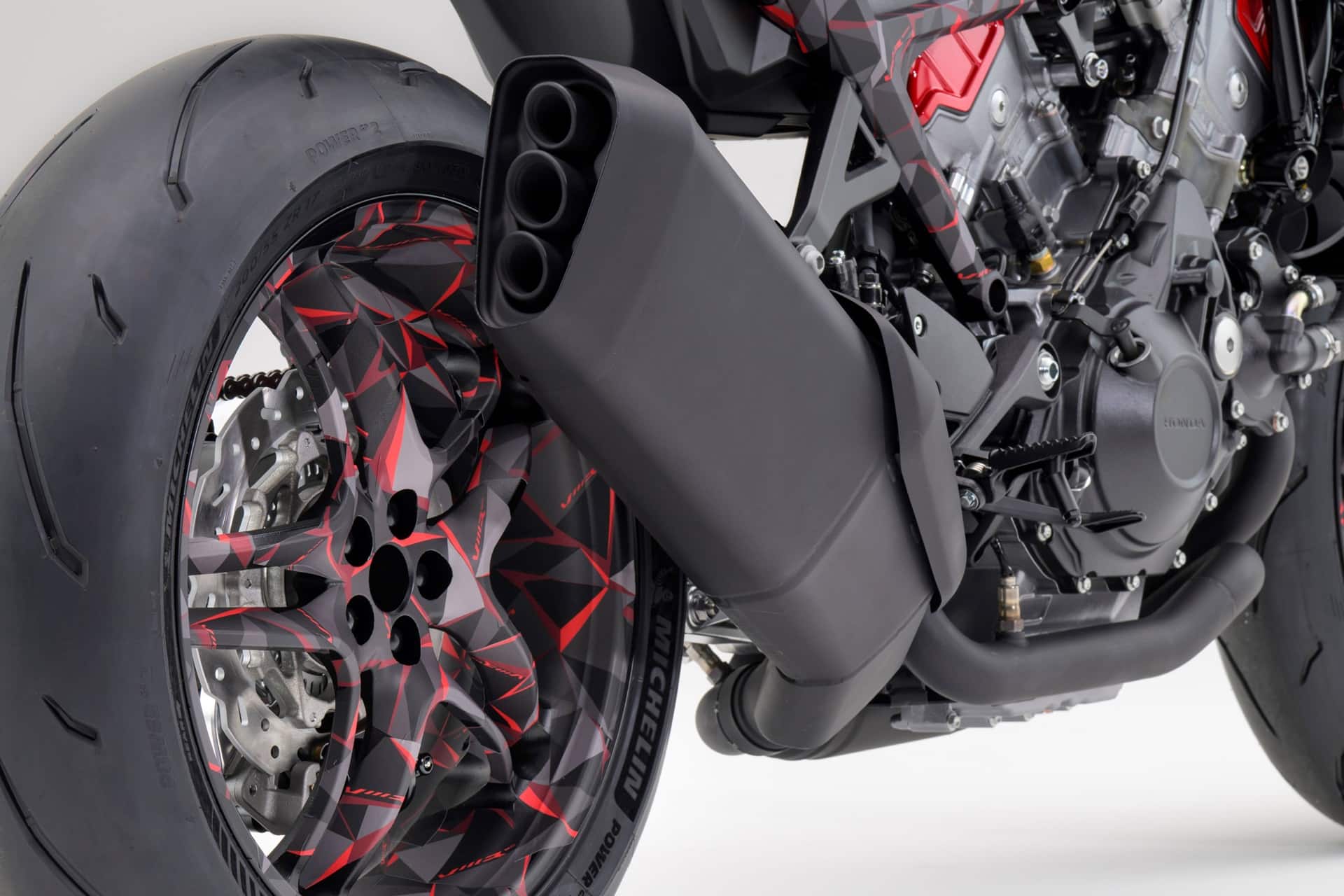
One of the most relevant data about the V3 engine with electric compressor shown by Honda in 2024 is that, according to the brand, the system does not require an intercooler.
This is much more important than it seems. Adding an intercooler means more volume, more ducting, more weight, more heat to manage and more design complexity. If Honda has achieved effective supercharging without the need for an intercooler, it may have gained a decisive advantage.
It also helps explain why the V3R feels so compact for a supercharged bike. We are not facing a forced adaptation of automobile technology, but rather a system designed from the beginning for a motorcycle.
6. Asymmetrical air intakes have function, not just aesthetics
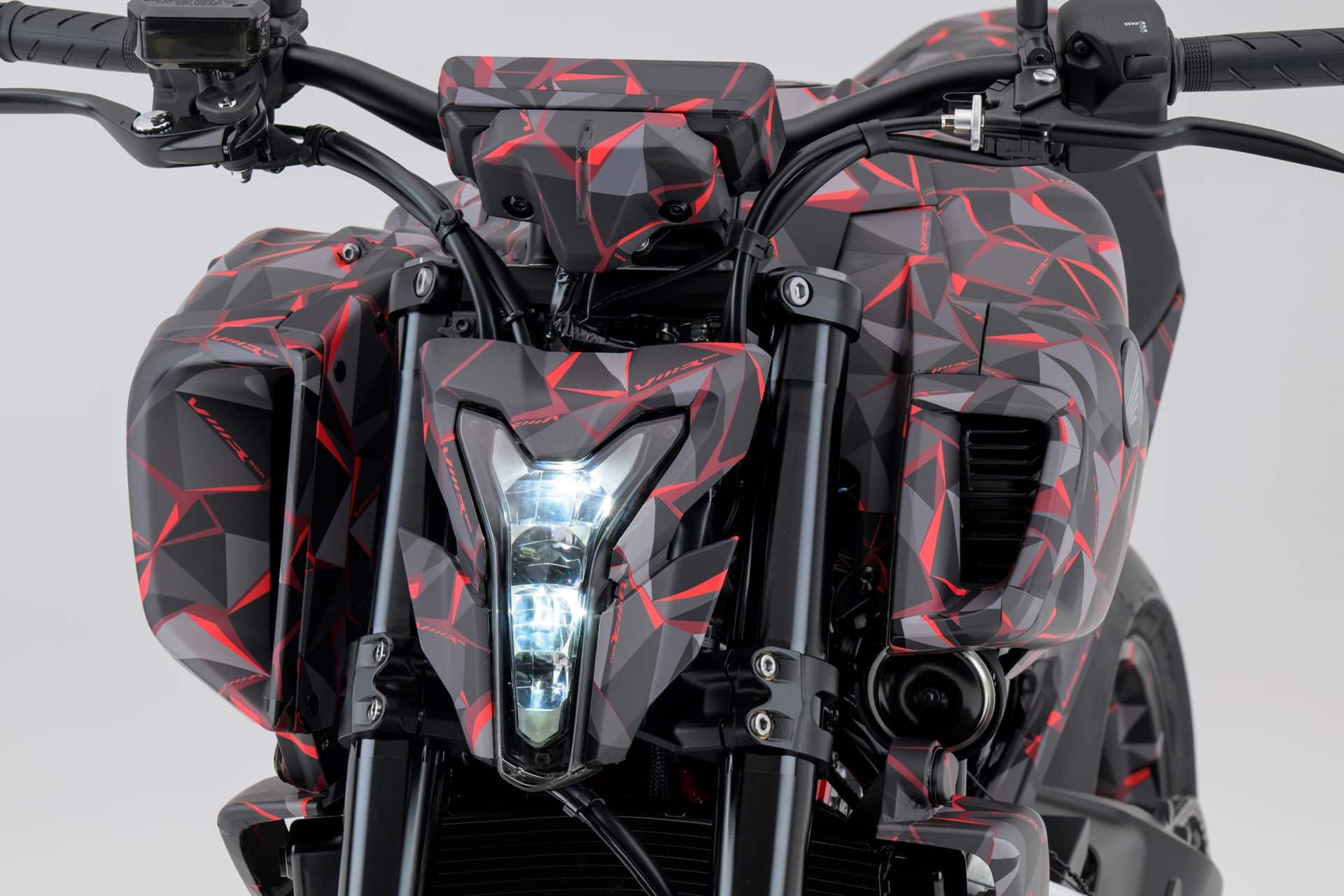
The asymmetrical side fairings are one of the visual hallmarks of the V3R 900 E-Compressor. Honda expressly mentions them in its official information, along with the new “Honda Flagship Wing” emblem on the tank, which the brand reserves for future high-level models.
On a motorcycle with an electric compressor, air flow is critical. A part of these ducts may be intended to feed the intake, another to cool electrical or electronic components, and another to manage thermal evacuation. What is relevant is that the asymmetry does not seem like a simple design whim: it responds to an internal layout conditioned by the engine, the compressor and its cooling needs.
These types of solutions usually appear when a motorcycle is not designed around aesthetics, but around a mechanical architecture. And that’s usually a good sign.
7. It is a prototype, but Honda is already talking about production
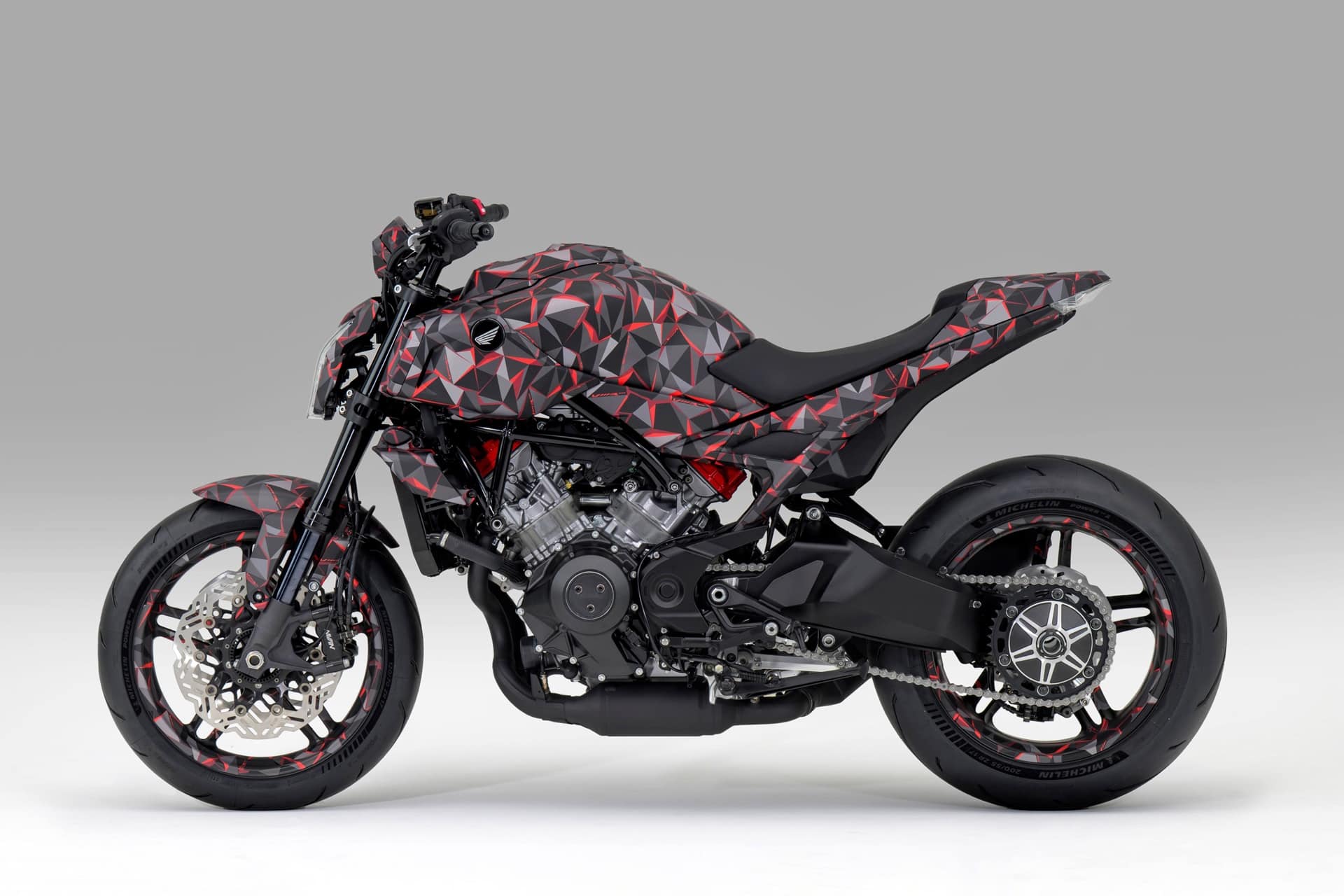
The last key may be the most important. Honda has not presented the V3R 900 E-Compressor as a fantasy without a commercial tour. The brand states that it will continue developing the model for mass production, a very different expression from that used when a manufacturer only wants to show off technological muscle in a living room.
There is still no date, price, power or definitive version. But the message is clear: Honda wants to take this technology to the streets. And if it does, it can open a new era for combustion sports motorcycles.
The V3R 900 E-Compressor does not seek to be revolutionary just because it has an electric compressor. It is because it tries to solve several problems at the same time: more performance without increasing displacement, more torque without losing control, more emotion without giving up efficiency and more technology without turning the motorcycle into a laboratory that is impossible to drive.
If Honda manages to translate all this to a production bike, the V3R will not simply be a new sports naked. It will be a demonstration that the combustion engine still has room to surprise. And, above all, that motorcycle innovation is not only about electrifying everything, but also about reinventing what we already thought we knew.