Training in a motorcycle course as a response to the human factor
Currently, road accidents continue to be a major social challenge, with 1.19 million of annual deaths worldwide. In Spain, while the general accident trend shows slight stability, motorcycle accidents maintain stagnant figures with a slight rebound on interurban roads.
The data is revealing: the 94% of traffic accidents are related to the human factor (distractions, speed or substance use), while the condition of the vehicle and the environment only represent 2% each. This reality shows that the most effective measure to reduce mortality is to act directly on the driver’s behavior and training.

Faced with this scenario, the Japanese brand has placed safety at the center of its global strategy under the ambitious “Goal 2050”, which seeks to achieve zero fatalities in accidents involving a Honda vehicle.
This goal, which contemplates an intermediate step of reducing deaths by 50% by 2030, is not a commercial commitment, but a key piece of its corporate social responsibility. To achieve this, Honda is committed to a comprehensive approach that combines preventive technological innovation with a solid structure of continuous training for the motorcyclist.

The backbone of this training in our country is the Honda Institute of Safety (HIS), a reference center in Europe that since 1992 it has trained more than 34,000 participants under the highest quality standards. In order to expand this methodology, the brand has launched the “Honda Approved Center” certification, a quality seal that guarantees that external schools comply with its demanding pedagogical processes.
In this context, ASR (Actividades Sobre Ruedas), directed by Rodolfo Martínez, has become the first school in Spain to obtain this certificationafter a rigorous training process with international instructors to absorb the defensive and preventive driving philosophy promoted by the HIS.
From theory to layout: How to experience a defensive driving course
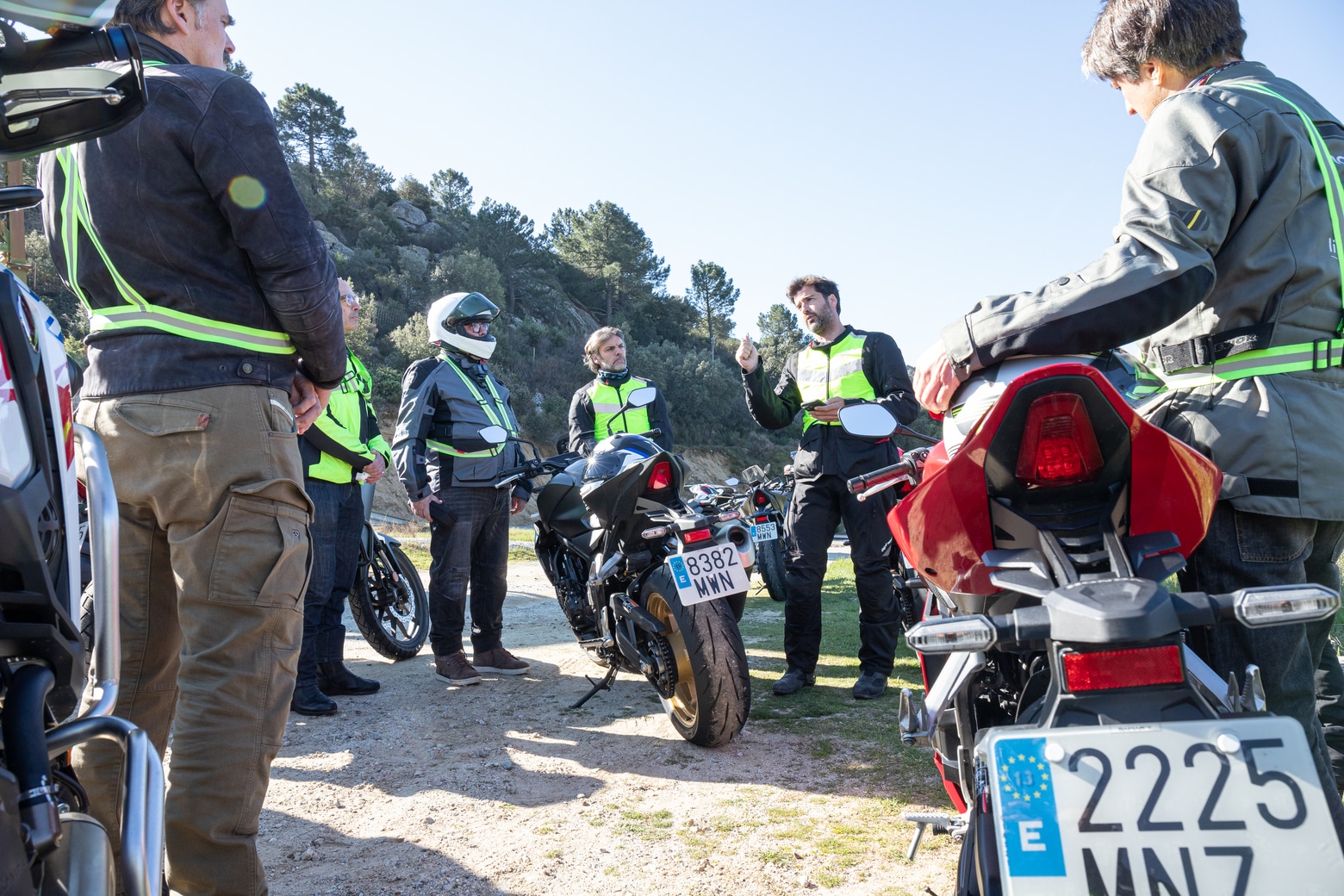
What differentiates this proposal from other piloting courses is its realism; We are not in a closed environment or a circuit, but on the open road, specifically traveling the routes of the Sierra de Gredos and Ávila that we bikers in the central area are so familiar with.
The structure moves away from the typical theoretical “plate” to become a route between friends, but with a constant professional supervision. Throughout the day, stipulated thematic stops are made where the instructors evaluate critical aspects such as position, gaze technique or curve crossing, encouraging a continuous dialogue with the student instead of an instructive monologue.

One of the strengths that I valued most as a trainee is the commitment to quality over quantity, thanks to a ratio of one instructor for every four students. This closeness allows for personalized monitoring that is supported by the intelligent use of technology: 360-degree recording cameras.
The interesting thing is not only that they record you, but that, during the meal, the monitor sits with you tablet in hand to review the images. Seeing your own posture errors or too strong entry into a corner in real time is simply the best way to assimilate the concepts and reflect on your own driving.

However, as I always maintain, it is vital to understand that a course is not a vaccine. This is not a certification that makes you immune to danger forever once the day is done. It is a tool to acquire concepts and observe vices that one alone is not able to see; It is a learning that must be applied in each subsequent outing.
My personal philosophy, which fits perfectly with what I learned at this event, is that We must drive as if all the traffic is out to annihilate us.. It sounds extreme, but it is the only mentality that guarantees maintaining an optimal level of attention and a real ability to anticipate the unpredictability of the road.

Finally, it is important to highlight that this initiative, although promoted by Honda through its dealers, is an exercise in corporate social responsibility. open to users of all brands. It is not a commercial strategy to sell motorcycles, but a real commitment so that everyone, regardless of what we ride, returns home safe and sound.
At the end of the day, the goal is for any motorcyclist, regardless of their level, to take home practical tools to enjoy this hobby in a much more conscious, safe and responsible way.
An invitation to improve: How to be part of this initiative
To conclude, I want to emphasize that this is a wonderful initiative that, from my point of view, everyone should take advantage of. My feeling after participating as a trainee is extremely positive.; It seems to me that both the ratio of monitors and the work methodology are totally correct.
At the end of the day, you realize that any rider, regardless of their level of experience, is going to take away something valuable and practical to apply on their next ride. No one knows so much that they can’t learn something new, especially when it comes to safety and reducing the chance factor on the road.

One point I would like to reiterate is that this training is not an exclusive club for brand owners. This security program is open to users of all brands.
So even if you don’t drive a Honda, You can find out and sign up through the official websites of the Honda Institute of Safety (HIS) or the ASR Driving School.
You can also visit your nearest official Honda dealer to check the course schedule and availability of places. For my part, I can only encourage you to take the step; Good training is essential so that we continue to promote a much safer and more responsible motorcycle culture.