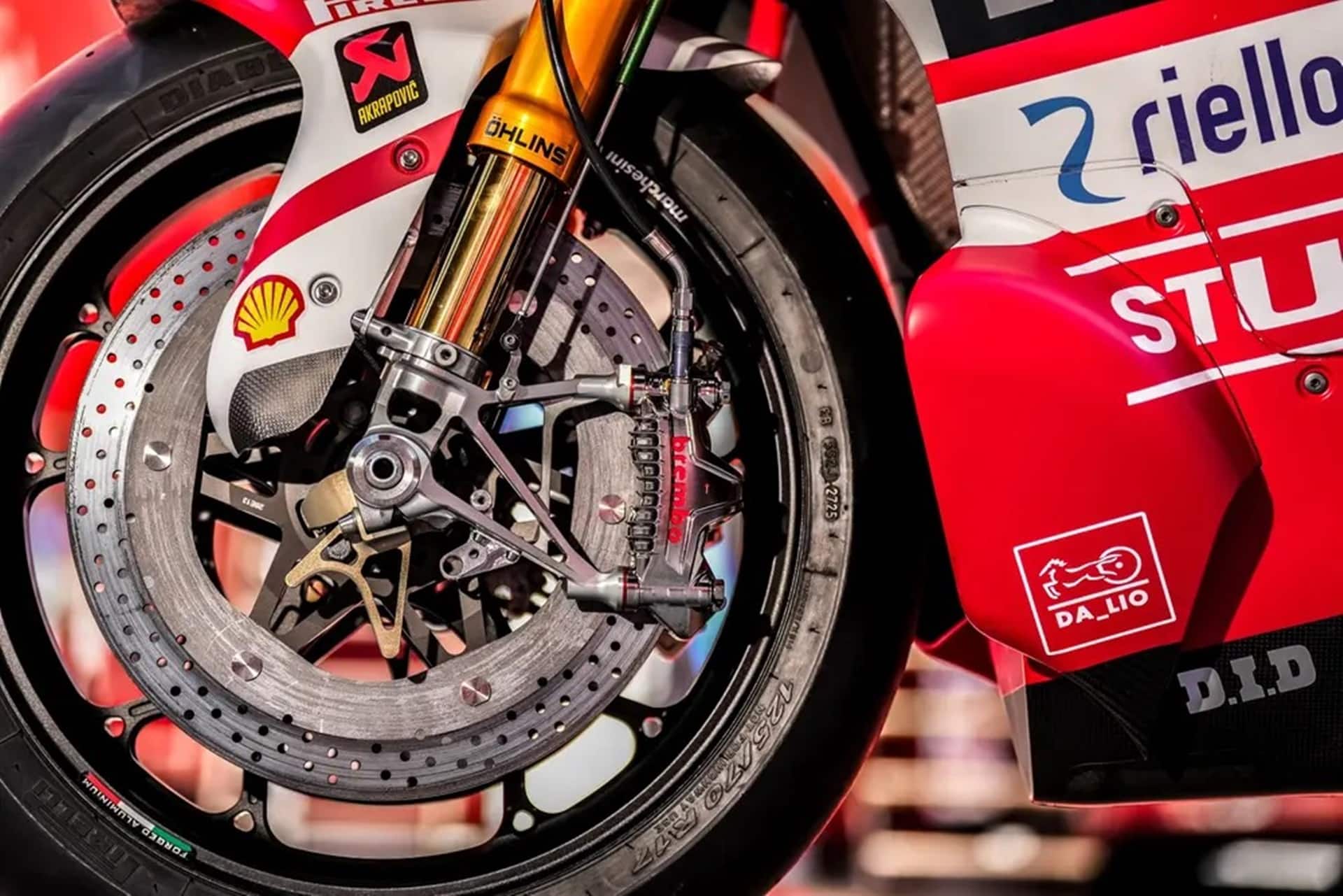
Since it was recently announced that Brembo will become the sole brake supplier in WSBK starting next season, introducing the Hyction technologyits innovative carbon-ceramic brake disc, we wonder if the next step in its industrial development involves its use in current street superbikes.
Under the motto of “democratizing” this type of innovative systems, it is likely that we could see them implemented on registered motorcycles sooner than we think. In fact, the new (and unattainable) Ducati Superleggera V4 Centenario has become the first production motorcycle to include this equipment within its standard equipment.

Hyction: the paradigm of “hyper-action”
There is no doubt that the Superleggera V4 Centenario is a niche motorcycle, collectible and available to only 500 lucky people. However, it is possible (due to pure commercial logic) that the Brembo Hyction system installed by the Italian could be used in other high-specification sports frames. Let us remember that in the exclusive limited edition of the Borgo Panigale, it acts together with the new GP4-HY clamp and a floating steel rear disc.
Technically the entire architecture is supported by a floating system derived from MotoGP, designed to maintain stability and performance even under the highest thermal loads. The Brembo Hyction carbon-ceramic disc introduces unprecedented solutions in the segment. With a diameter of 340 mm, a thickness of 8 mm and a braking surface of 35 mm, Hyction has 132 ventilation holes meticulously located to maximize heat dissipation.

A newly developed asymmetrical aluminum hood reduces weight while maintaining high rigidity, in harmony with a distinctive non-circular interior profile. Completing the package is an all-new geometry designed to reinforce all six drive points and further reduce rotating mass.
Weighing only 1,375 grams, the disc offers a reduction of 450 grams per unitequivalent to 900 grams per wheel, along with a drastic 40% decrease in inertia compared to a steel disc for road superbikes. This results in faster direction changes, greater responsiveness and improved steering precision. Or what is the same, a plus in handling and safety that, taken to a street motorcycle, would exponentially improve the riding experience.

Although it is likely that we will never see Brembo Hyction technology offered as standard, it is possible, as is already the case in the sports car sector, that many brands will include it in their list of options. We assume that it would not be cheap to set up a system of this caliber, although as usually happens in other markets related to products loaded with exclusivity, they finally end up adjusting their rate in favor of expanding demand.