Recently, Honda registered new patents on a future plug-in model. More specifically, what seems, at first glance, a possible CB1000R electric. And no, it is not the first time that the Japanese brand shows us different options with which to debut within the EV sector with a motorcycle. So far it has launched several models of electric scooters on the market, including the new Activa, Honda’s new urban electric scooter with interchangeable batteries.
In this new patent registration, which we have learned about thanks to our colleagues at Cycle World, Honda goes one step further with a high-performance mount that could well be an electric CB1000R.
In fact, the brand uses key parts of its maxinaked for the design, such as the fork, the headlight or the single-sided swingarm acting with a Pro-Link rear suspension system. It even equips a fuel tank with a filler cap, although below this we would find an AC charging port.
A high-performance electric CB1000R
What stands out most about the design of this electric CB1000R is, without a doubt, the high-capacity battery pack installed in the place where we conventionally find the combustion engine. A total of four batteries, placed in an almost horizontal position, can be charged using a CCS2 type plug, allowing fast charging at stations enabled for it.
The equipment is cooled by liquid thanks to a small radiator installed behind the front wheel. The power, for its part, reaches the rear wheel through a belt that, in turn, works with different gears and a transverse axle installed on the right side of the motorcycle. Other relevant details that these patents show us are, for example, how Honda provides this electric CB1000R with a tubular frame in charge of embracing the battery pack.
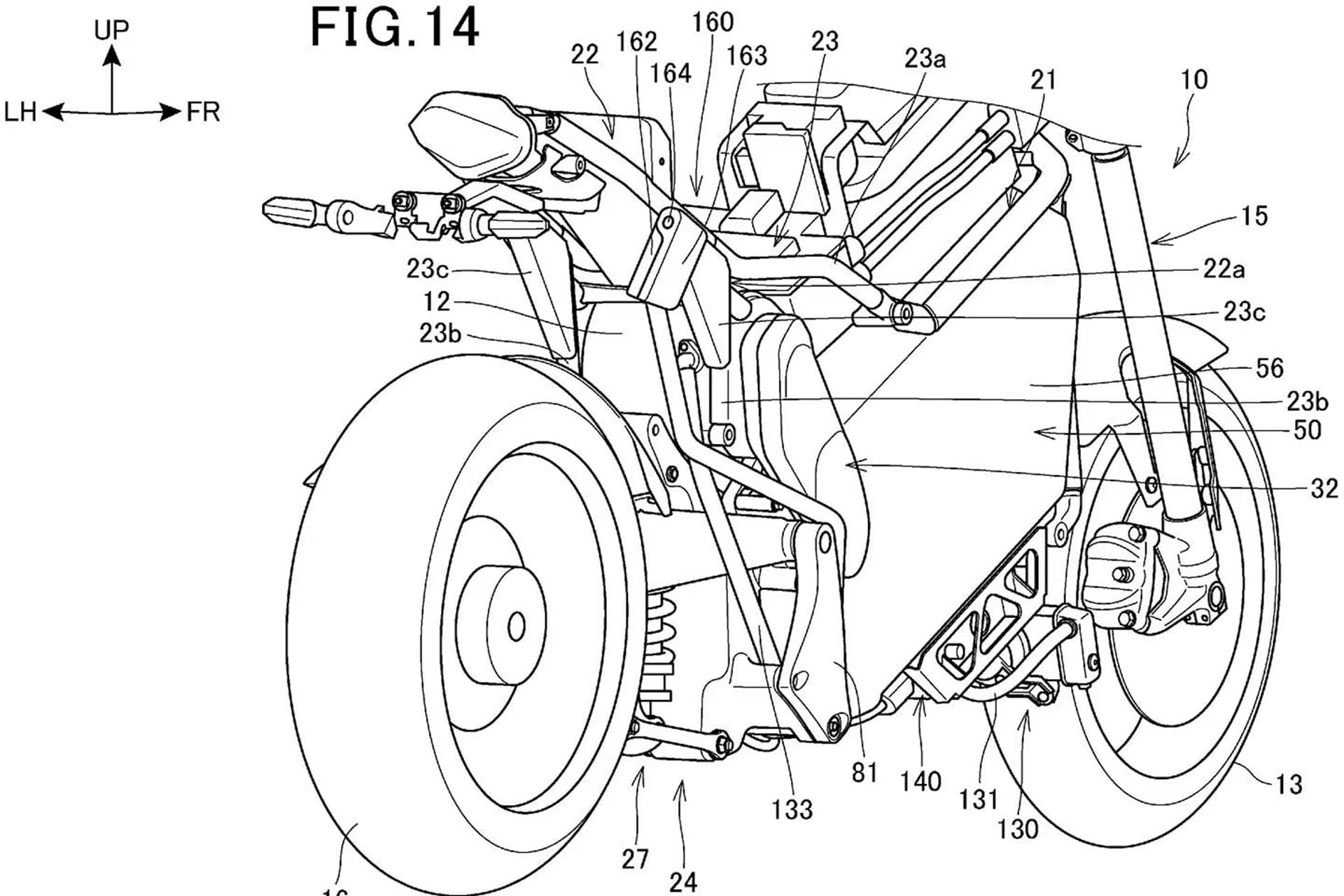
Likewise, the upper part of the motorcycle, the rider’s and co-pilot’s seats, maintain a design similar to that shown by the current CB1000R. Also the position of the handlebars, rearview mirrors and dashboard. Undoubtedly, in a hypothetical electric CB1000R the figures related to the geometries would vary, especially due to the need to seek a center of gravity as low as possible.
What is clear is that Honda follows the roadmap set for the year 2050, where the brand intends to declare itself carbon neutral. We don’t know if by then, or much sooner, we will see an electric CB1000R circulating. Nor if some of the solutions used in this design could end up being implemented in future models of the Japanese firm, something that seems more likely than this first.