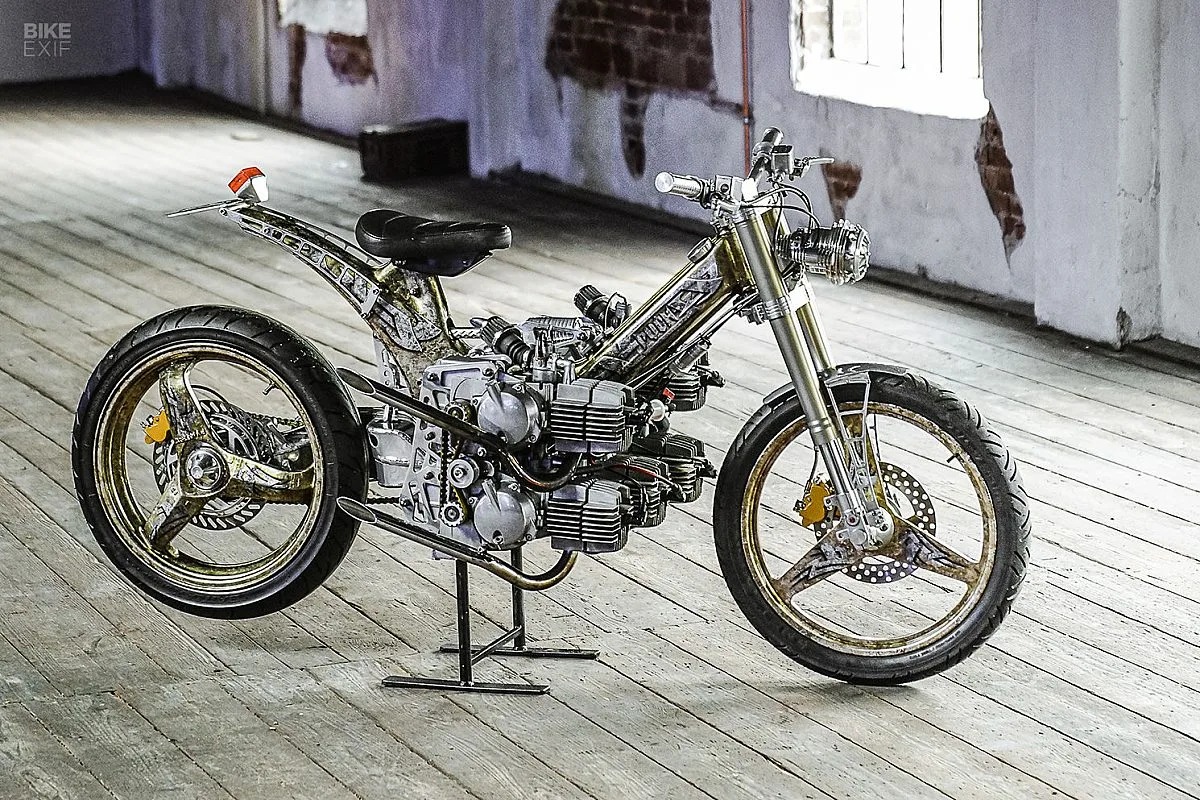
Surely some of our readers, in their younger years (back in the late 70s and early 80s of the 21st century), were lucky enough to enjoy a Puch Maxi. What you most likely never imagined is that up to 5 cylinders could be installed on this one. Much less so that these were prepared to reach a final displacement of 70 cc with the purpose of achieving a “three and a half” 2T that is difficult to explain.
You may be interested in: Peugeot 103 Diabolique, the wild 8-cylinder, 400 cc moped
Puch Maxi S by Uwe Oltmanns in detail
Behind this bizarre project is Uwe Oltmanns, a well-known German in the world of preparations. To his credit is having extremely modified some Opel cars intended to compete in acceleration races. Furthermore, he is passionate about “MOFA” (short for MOtor-FAhrrad, which in German means motorcycle) and especially vintage mopeds like this Puch Maxi.
According to Bike Exif, the model was very common in the country due to the plain that surrounds the North Sea. Also the preparations around its simple platform, although Oltmanns has another point of view on the latter. The most reliable proof of this is this five-cylinder, 350 cc Puch Maxi S 2T. More than one will wonder how something like this can be put together, although a priori everything seems to have a more or less coherent technical explanation.

Starting with a 1976 Puch Maxi S, Uwe acquired four other Puch engines. After completely disassembling all of them, he modified the cylinders to reach a displacement of 70 cc in each one, resulting in a total displacement of 350 cc. The ideologue of the project explains that each of them is equipped “with a round slide carburetor and a flywheel clutch, plus a large diameter exhaust manifold.”
Concludes: “The bottom three motors are connected by a central shaft, with two independent belt drives linking motors four and five.” At the chassis level, it maintained the original chassis, although at the rear it included a rear swingarm developed specifically for the Aprilia RS 125 R driven by Ralf Waldmann in 1993 in the World Championship.
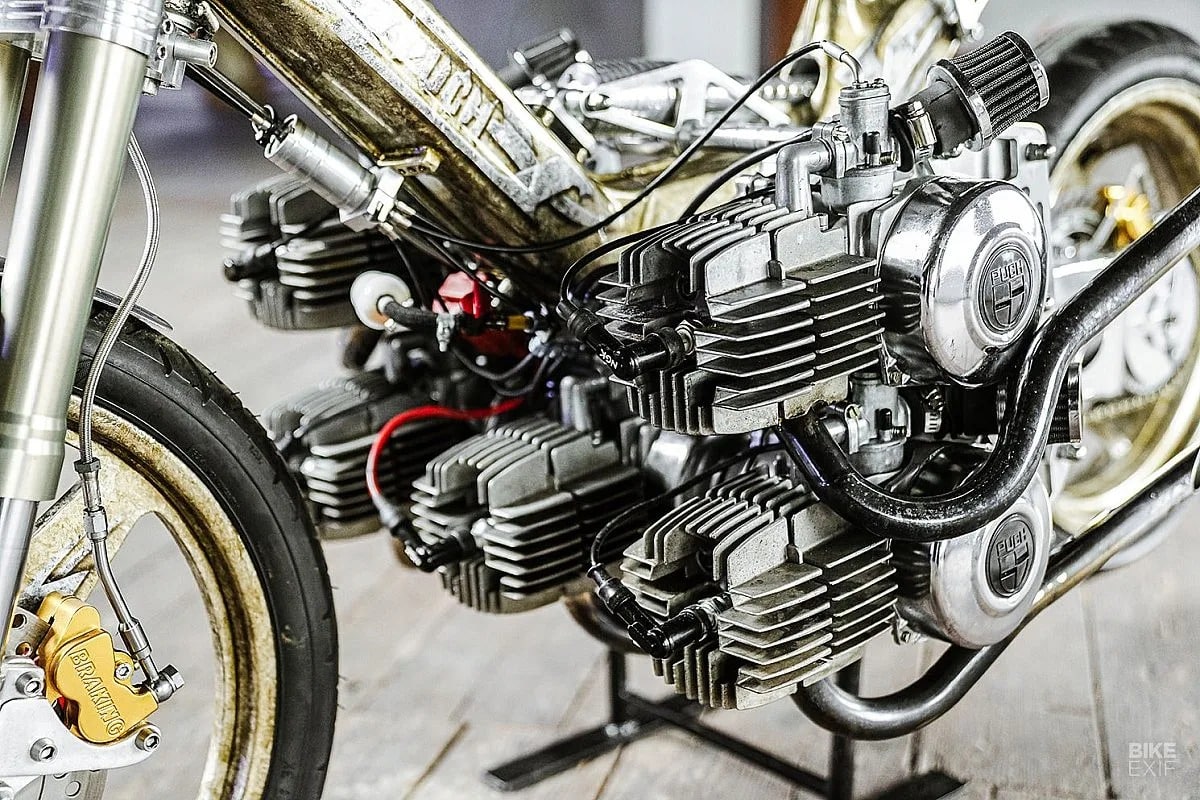
After adapting it to the Puch Maxi “He connected it to a hidden mountain bike shock using a few CNC machined parts. A three-spoke magnesium rim from PVM completes the bike’s aesthetics”our colleagues conclude. For the suspension of this eccentric preparation, Uwe opted for a WP fork also belonging to Waldaman’s Aprilia.
As expected, there was no way to install it without carrying out multiple modifications. Among them, the CNC seat posts machined by Oltmanns in his personal workshop stand out. He also manufactured the handlebar risers and grips, as well as the inside of the front rim, matching the design of the rear one.
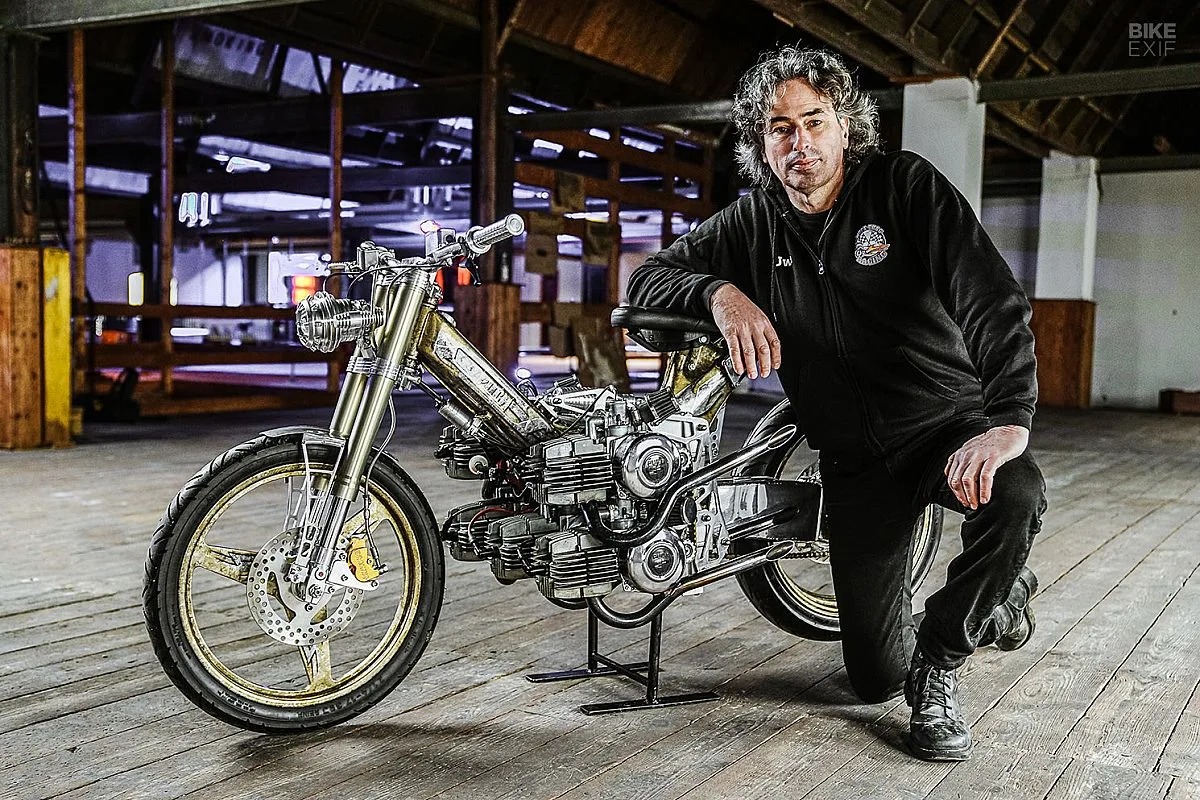
For braking, Braking calipers and stainless steel discs were chosen, while the decoration, based on airbrushing and textured paint, was the work of Pfeil. As a curiosity we have the story that surrounds the headlight of this Puch Maxi S. According to Ven Wedemeyer, a friend of the creator and photographer:
“Uwe had an idea at five in the morning after a long party. So he immediately started CNC machining it, using BMW Z8 Prism technology. Then he went to sleep and the next day he was quite surprised at what he had done”. Regarding its operation, it could be summarized in a single word: undriveable.
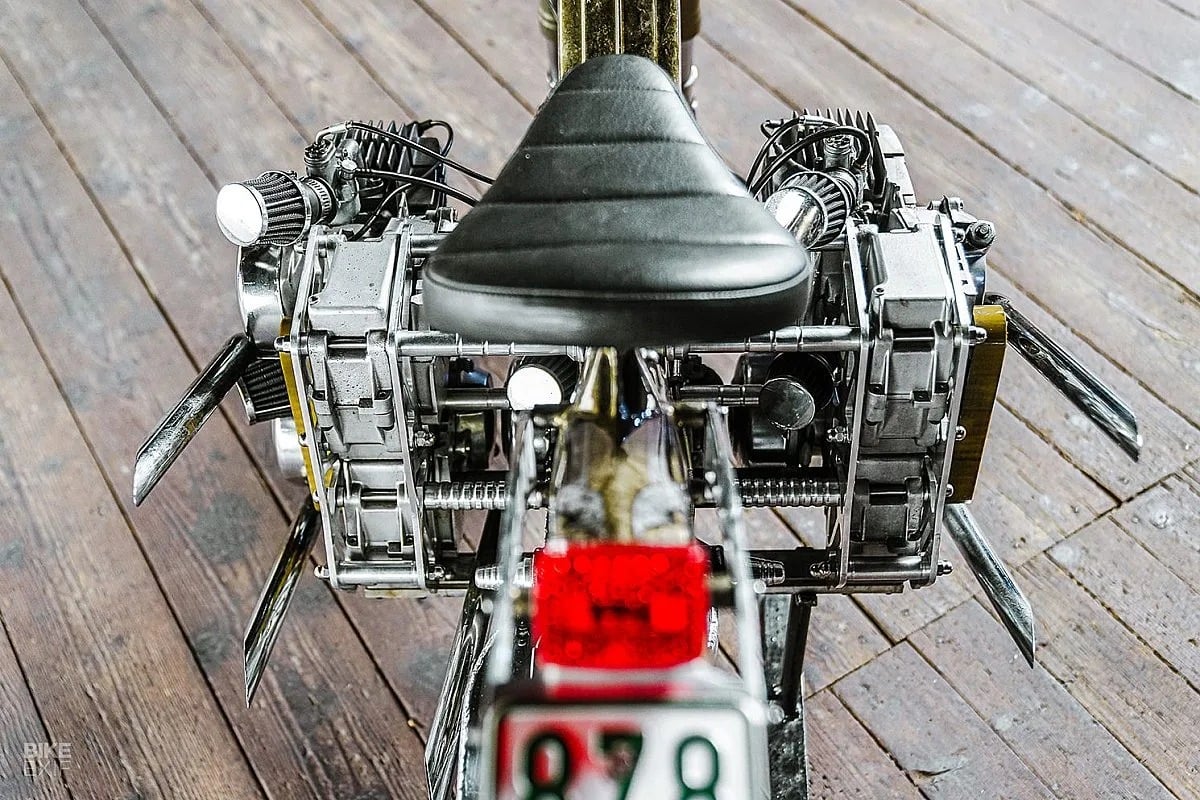
Basically, the heat and noise (127.5 decibels) emanating from its 5-cylinder engine is unbearable. Then we have “the technique” that must be used to start it: “Uwe spins the rear wheel to start the first engine. Once hot, each of the following engines is activated one by one by releasing their clutches with a wrench.”
Having said this, you may be wondering “And to be able to turn it off?”… it is only possible if we remove the five spark plugs. Far from being intimidated, Uwe is immersed in his new mechanical madness. If this 5-cylinder Puch Maxi seems like a monumental trip to you, wait until you see the V10 with a longitudinal crankshaft that it is preparing. Simply wonderful!