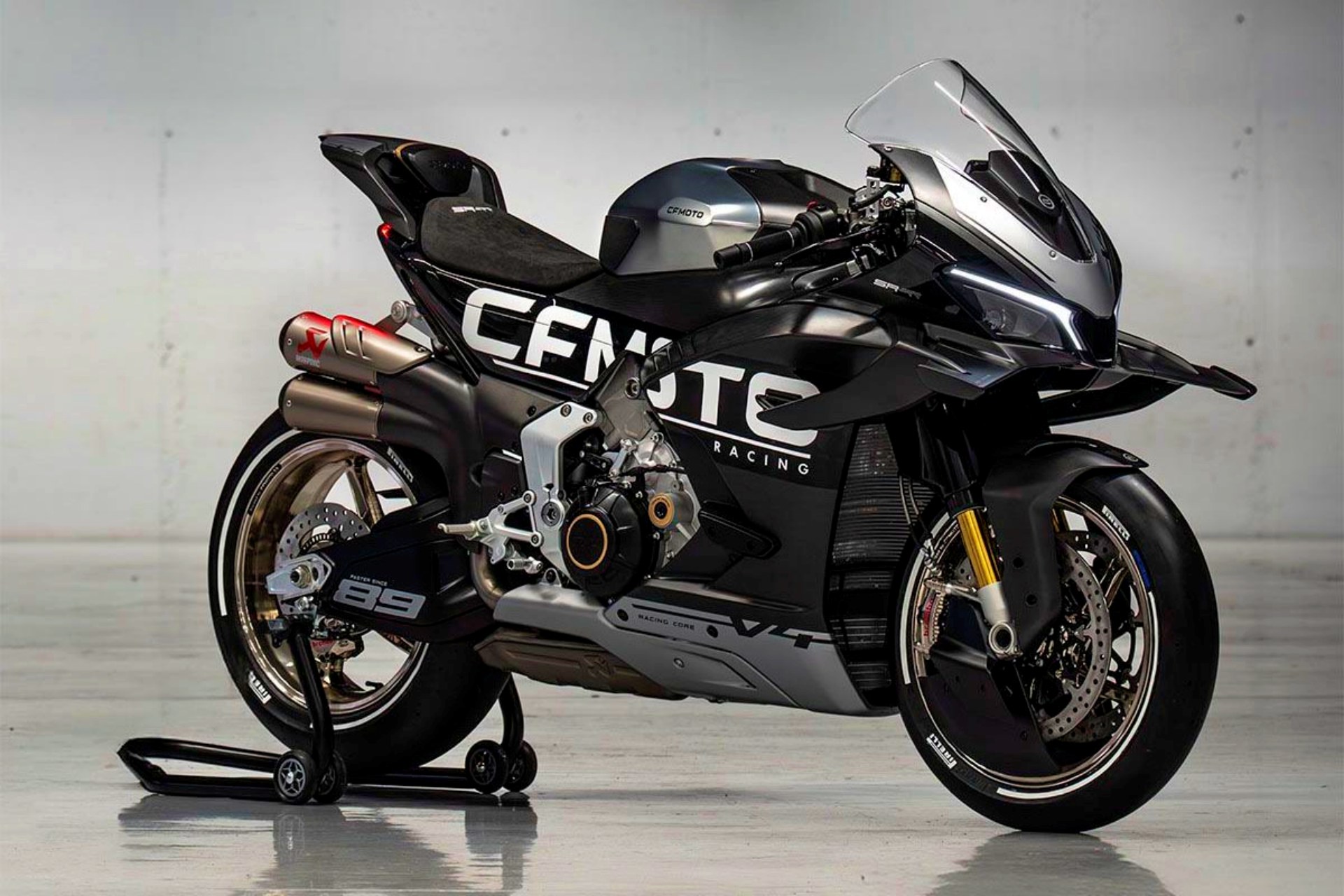
CFMOTO continues to develop the V4 SR-RRa superbike with which it intends to compete in the territory of the major European and Japanese sports teams. Now, the latest patents registered in China allow us to better understand the architecture of its 997 cc engine and discover a possibility that until now had gone more unnoticed: “a configuration with a turbocharger.”

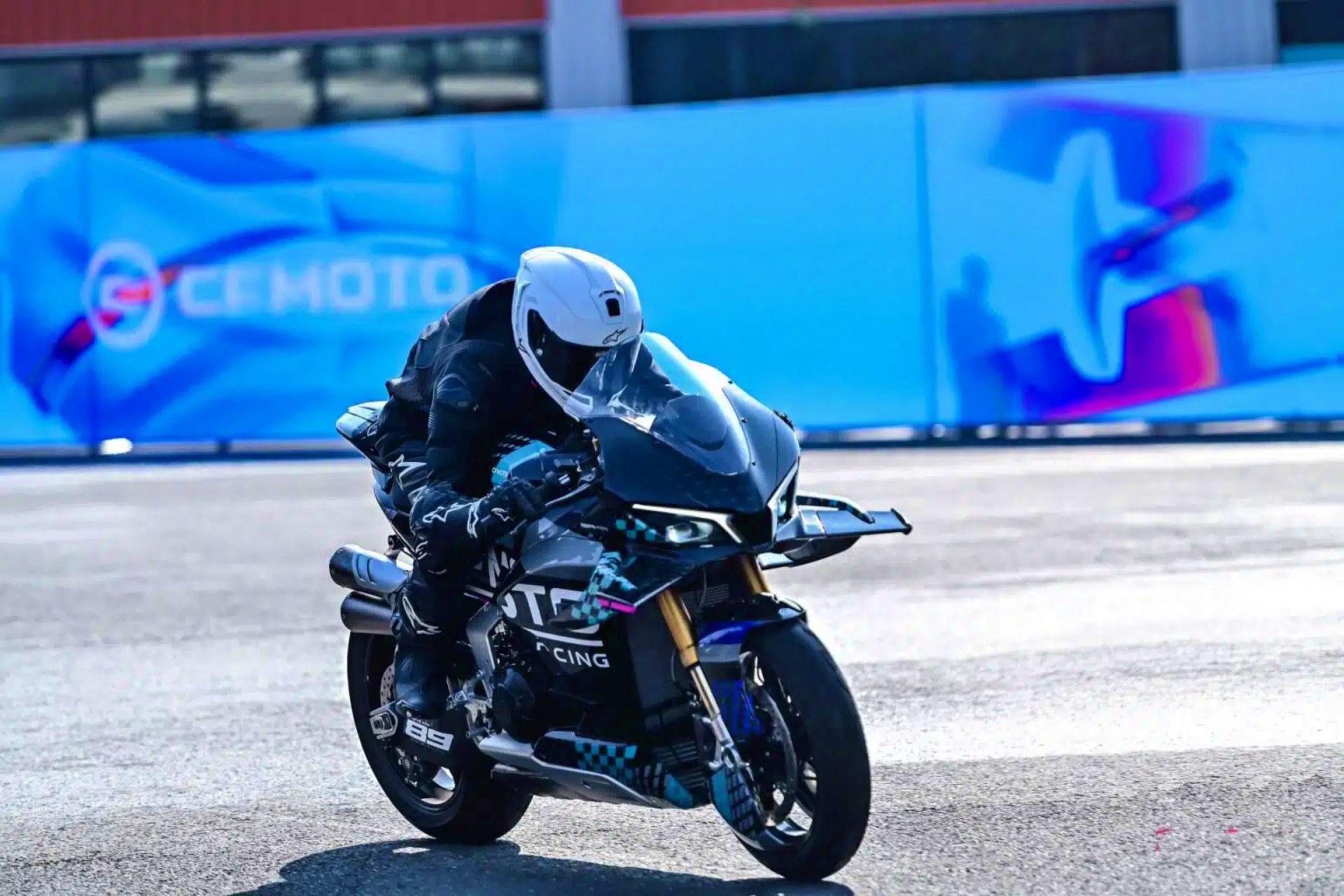
The project has already surpassed the phase of simple static prototypes. After showing the engine for the first time in EICMA 2024 and present the complete motorcycle in the 2025 edition, the Chinese brand has continued working non-stop on its tuning. In June 2026, the V4 SR-RR reached 315.82 km/h in a GPS-verified speed test, becoming the fastest Chinese motorcycle in history, while in September we were able to see it ride on the circuit with riders like David Alonsofrom the environment of Aspar Team. As we also told you.
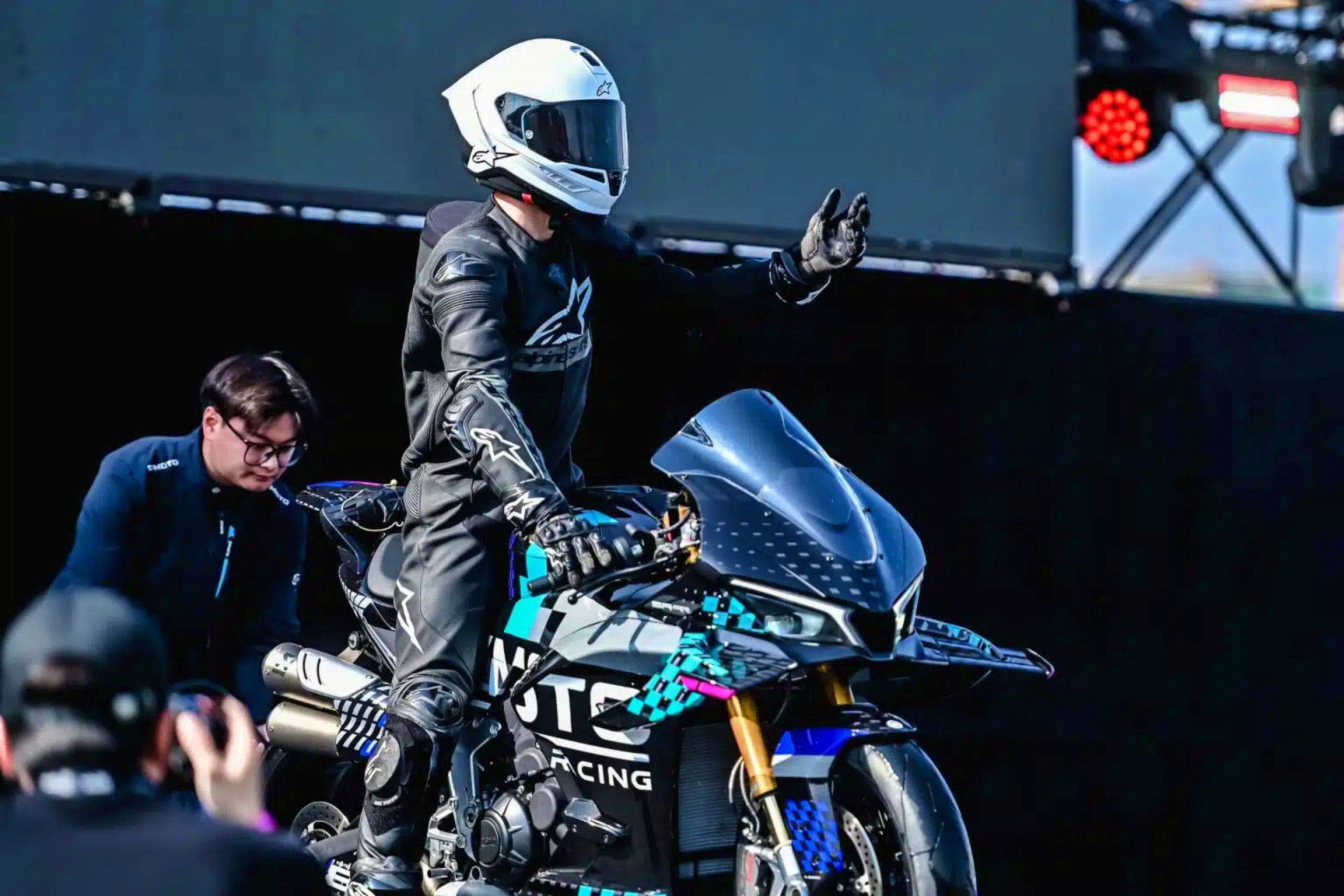
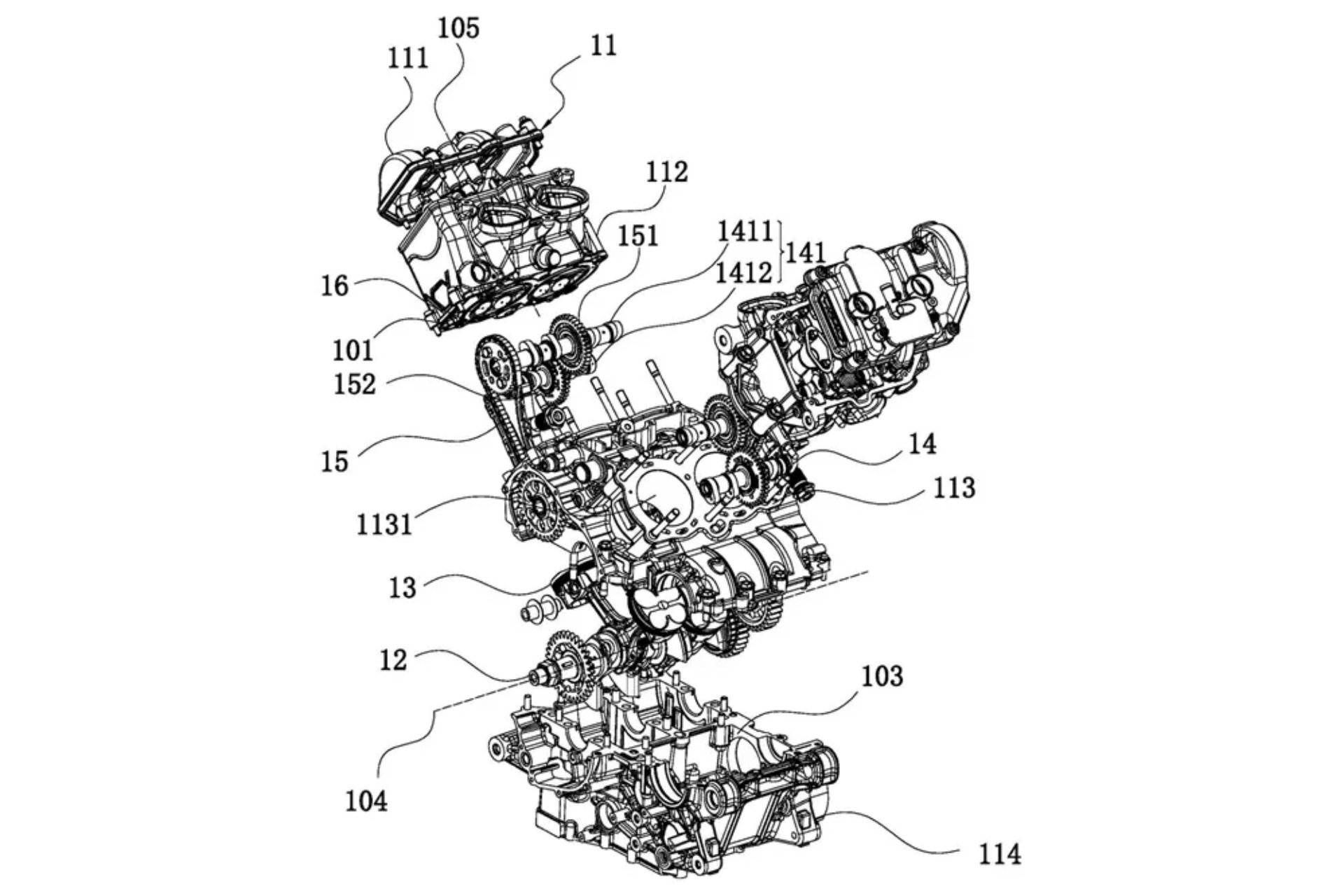
Now, no more and no less than 11 patent applications provide additional information on the engineering decisions of CFMOTO. Although much of the documentation focuses on specific mechanical solutions, the set makes it clear that the firm is working on a mechanism designed to offer top-level performance, with special attention to the intake, distribution and integration of the engine in the frame.

And if. The possible supercharging is the most striking detail, but it is advisable to keep our feet on the ground: just because a patent contemplates a turbo engine does not mean that it will end up installed in a superbike of production. It could also be a solution intended for other vehicles of the brand.
CFMOTO V4 SR-RR, a 997 cc V4 with more than 210 hp
The mechanical heart of CFMOTO V4 SR-RR It is a 4-cylinder 90º V engine, with a displacement of 997 cc, a diameter of 81 mm and a stroke of 48.4 mm. As we can see, these are levels that place its technical approach in the environment of the most radical superbikes, including the Ducati Panigale V4 R.
The announced power has evolved during the development of the project. In his initial presentation he spoke of 212 hpwhile later references place the objective around the 210cv, with a maximum speed of 14,500 rpm. The engine torque initially reported was 114 Nm at 12,500 rpm and the declared weight of the propellant, without liquids, is 61.5 kg.
Another important detail is the “counter-rotating crankshaft”, a solution that rotates in the opposite direction to the wheels and helps compensate for part of their gyroscopic effects. In practice, this approach seeks to encourage quick changes of direction and improve the dynamic behavior of a sports car designed to ride at a high pace.
The patents also show a “variable length intake system.” The intake trumpets are divided into 2 sections and a small electric actuator modifies the position of the upper part to adapt the operation of the system to the engine speed. At low revolutions, the configuration allows to favor the filling of the cylinders and the delivery of torque. When the speed increases, the moving parts change position to modify the effective length of the ducts and prioritize power at high revs. It is a solution that we also find in the technical approach of the Ducati Panigale V4.
The integration of the propellant constitutes another of the revealing decisions. The engine plays a structural role within the package, with a light alloy front section anchored directly to the cylinder heads. In this way, CFMOTO avoids resorting to a conventional structure that completely surrounds the block and seeks to reduce the volume of the whole.
The drawings also show how the air reaches the filter box by passing through the steering head pipe area. This route takes advantage of the effect of dynamic air pressure when the motorcycle moves at high speed, a particularly interesting solution in a sports car that has already exceeded 300 km/h during its tests.
CFMOTO V4 SR-RR: Different distribution than Ducati and Aprilia
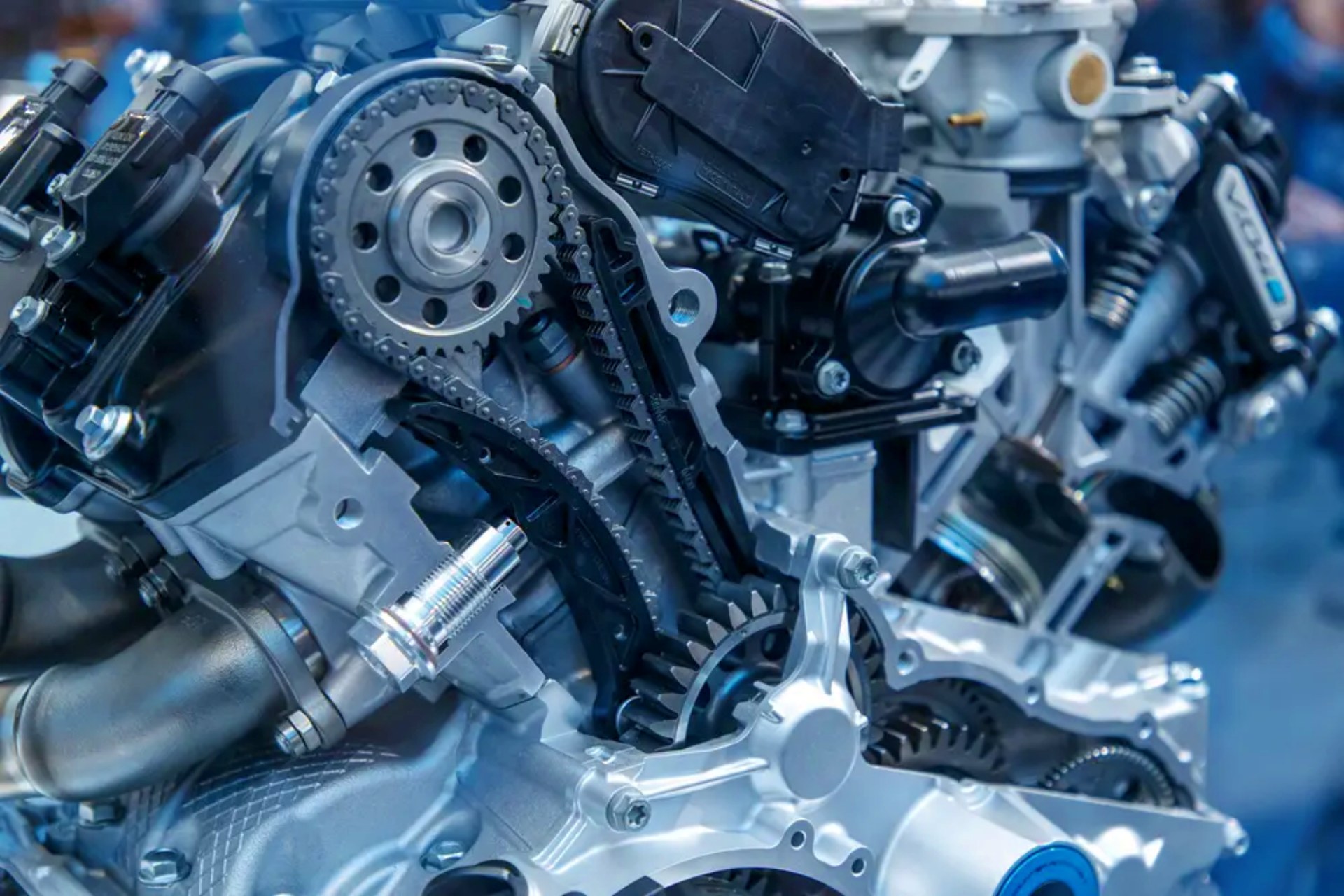
Inside the V4, CFMOTO has opted for finger rocker arms to operate the valves. It is a compact solution, common in modern sports engines, which allows working with precision at high speeds. The distribution also presents a particular layout. Each bank of cylinders uses a chain to drive the intake camshafts, while the exhaust camshafts are driven by gears. According to the documentation, this architecture allows the use of shorter chains and facilitates their tensioning, with the aim of improving the precision of the distribution and its durability.
The arrangement of the gears between the camshafts also helps keep the engine compact. In this section, the approach is reminiscent of solutions used in the Aprilia RSV4and distances itself from the characteristic desmodromic distribution of Ducati.
Will a CFMOTO V4 SR-RR turbo arrive?
The big surprise appears in one of the patent documents. When describing the cylinder head exhaust ducts, a configuration is expressly contemplated in which the gases are directed towards a turbine installed in that same area. In the case of the naturally aspirated engine, the evacuation is carried out through a conventional exhaust manifold.
The reference shows that “the engineers have technically contemplated supercharging”, but it does not allow us to ensure that CFMOTO is preparing a turbo version of the V4 SR-RR. Nor does it clarify the power it could achieve, its possible commercial destination or if it would reach the market.
The most obvious comparison would be with the Kawasaki Ninja H2which uses a mechanical compressor, although it is important to distinguish both systems: a turbocharger uses the energy of the exhaust gases, while a mechanical compressor receives the drive from the engine. Sling has also explored this avenue with the prototype V3R 900 E-Compressorwhich incorporates an electric compression system. As we also told you at the time.