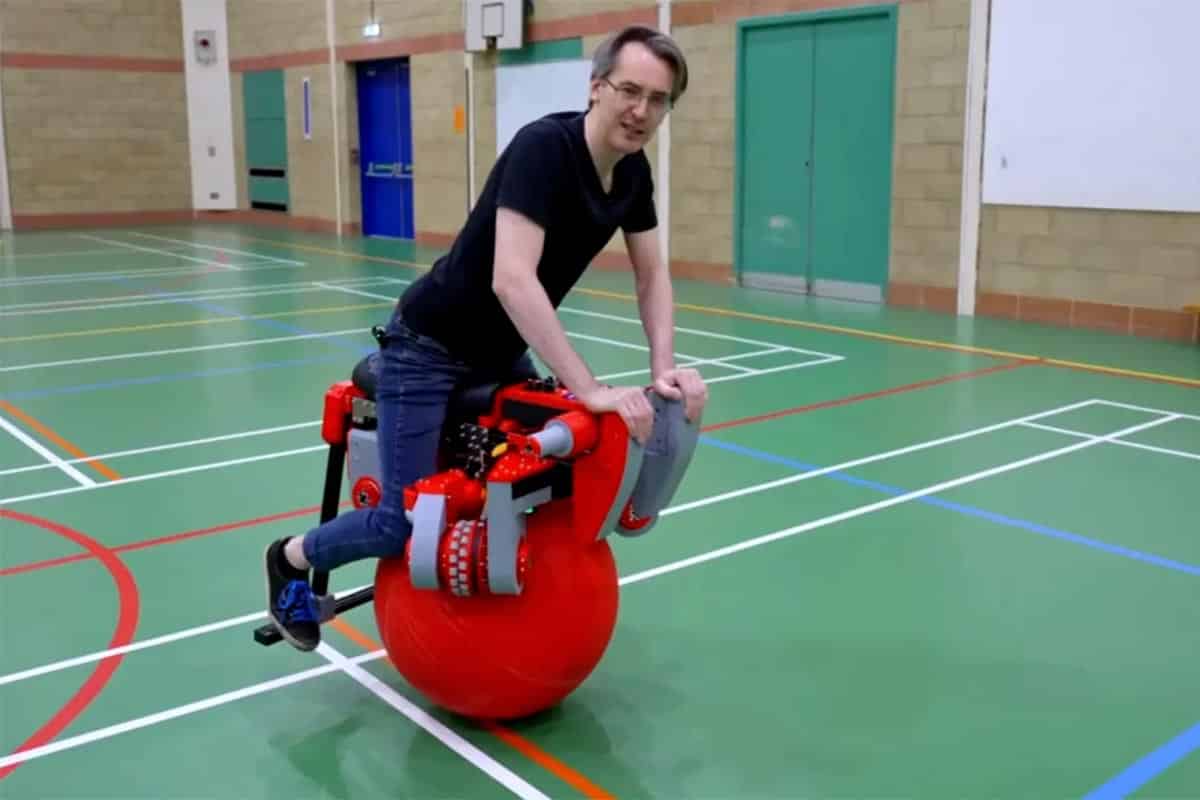
The inventor-youtuber James Bruton continues to think about, and never better said, his inventions of omnidirectional and electric motorcycles. We have already seen it on different occasions with creations of all kinds, including the first version in which I used two balls instead of wheels. But now Bruton has gone even further (or less, depending on how you look at it) and has created a mono-bike in which he has dispensed with one of those two balls.
As you can see, the motorcycle only has a large ball in contact with the ground and although it is the one that sets the direction to follow, it is actually three omnidirectional wheels that actually control it through the motors of up to 2 kW that they have. The secret is in their placement and their operation. They are at the top and are equidistant from each other, so they rotate at different speeds and directions and that is what makes Bruton’s mono-bike move in any direction… on paper.
And although it seems simple to explain, technically it was not so easy, because on this occasion he had to mount the wheels vertically. The reason is that this configuration prevents the passive rollers responsible for lateral sliding from blocking each other at higher speeds. So each of the 216 rollers in the system, with their bushings and tires, make the magic possible.
But, of course, this “magic” is not possible without a PID controller that works in conjunction with an IMU (yes, like that of a motorcycle). With the measurements, the inclination is continuously corrected, sending orders to the motors to maintain verticality. So much order consumes resources and for that James’ motorcycle has six batteries that deliver 50 volts, enough to operate the system and move the motorcycle which, by the way, has a chassis made of aluminum profiles.
Bruton has looked for effective and eye-catching solutions
Of course, reducing from two spheres to one has not simplified the project, quite the opposite. In the original version, direction was achieved by spinning each ball in the opposite direction. Now, with just one, that solution disappears and solving it becomes complicated because the whole has become, in Bruton’s words: “simply uncontrollable.”

To solve it, at least temporarily, he has made a decision that is as rudimentary as it is effective and that is that he has created a kind of foam rudder that works but that he has to carry with him. Its function is to help stabilize the direction, the most critical point at this moment although not the only problem. And the friction between the plastic ball and the rubber rollers generates static electricity that can generate electronic interference and has even caused sudden shutdowns.
The best thing is that, as Bruton usually does, he has published both the software and the CAD files of the design in open source, leaving the door open for future improvements. The next step will be to definitively resolve the steering problem, something that will determine whether this peculiar “mono-bike” can evolve beyond a technical experiment. We will see.