Honda’s “triple action to zero” concept is a corporate mantra, driving alternative thinking and smart solutions to reduce the impact of the company’s activities on the planet. These initiatives address carbon neutrality, clean energy and resource circulation as the three key factors to achieving zero emissions by 2050.
Beyond the manufacturing of electric motorcycles and cars, and changes in production and logistics centers to reduce CO₂ emissions, Honda has also adopted the use of alternative materials in several motorcycles, such as the Durabium. After its first application on the Africa Twin, the material is now present in parts ranging from handlebar covers to complete fairings.
The Durabio is already part of 6 models of the brand for 2026
For example, the SH125i and SH150i Vetro use unpainted semi-transparent fairing covers, the production of which generates 9.5% fewer CO₂ emissions per year at Honda’s Atessa factory, compared to standard painting processes. In addition, a total of six motorcycles in the Honda range in Europe incorporate pre-consumer recycled plastics, and Durabio, a bio-based engineering plastic developed by Mitsubishi Chemical Group (MCG Group).
It is already present in several production models and its use will be expanded. Durabio is derived from isosorbide, a cutting-edge plant-based material made from renewable sources such as inedible corn and wheat. Through a refining process, the natural starches of corn are converted into glucose, then into sorbitol and finally into isosorbide: a high-performance compound with multiple applications, capable of replacing chemicals derived from petroleum.

Unlike conventional engineering plastics, Durabio offers a unique combination of optical clarity, strength and surface durability. Its ability to provide transparency and intense color expression allows Honda to create sophisticated finishes without the need for paint, thus eliminating an entire stage of the production process.
In addition to offering an elegant and shiny finish, it has high scratch resistance, high impact absorption capacity and long-term UV stability, making it an ideal material for high-performance applications such as motorcycle components.
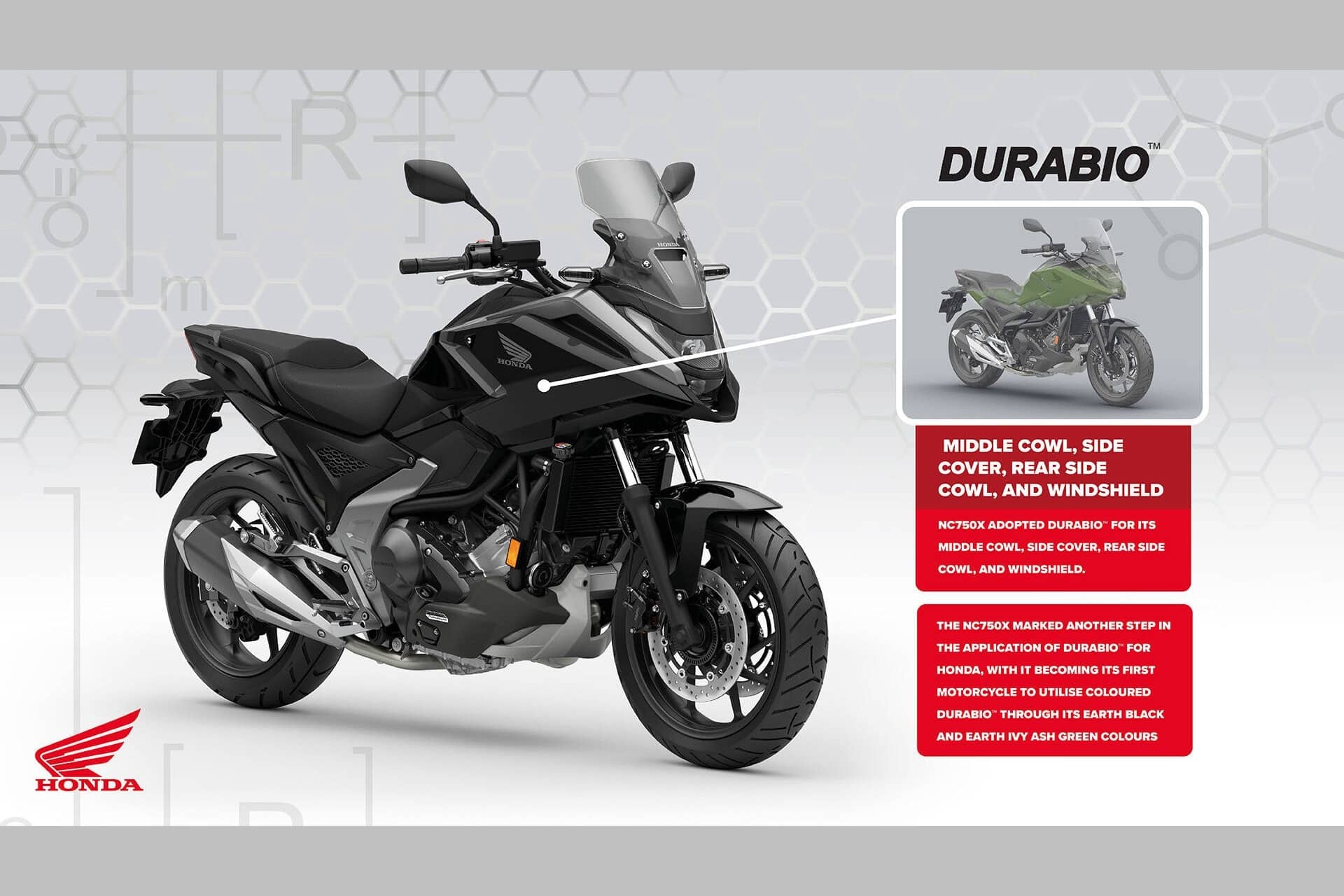
These features have been very well received by the specialized press in Europe, where Durabio is used in the fairings and screens of models such as the CRF1100L Africa Twin, the NT1100, the versatile NC750X, the CB1000GT, as well as the X-ADV and the Forza 750 maxi scooter.
The Durabio expands across the Honda range
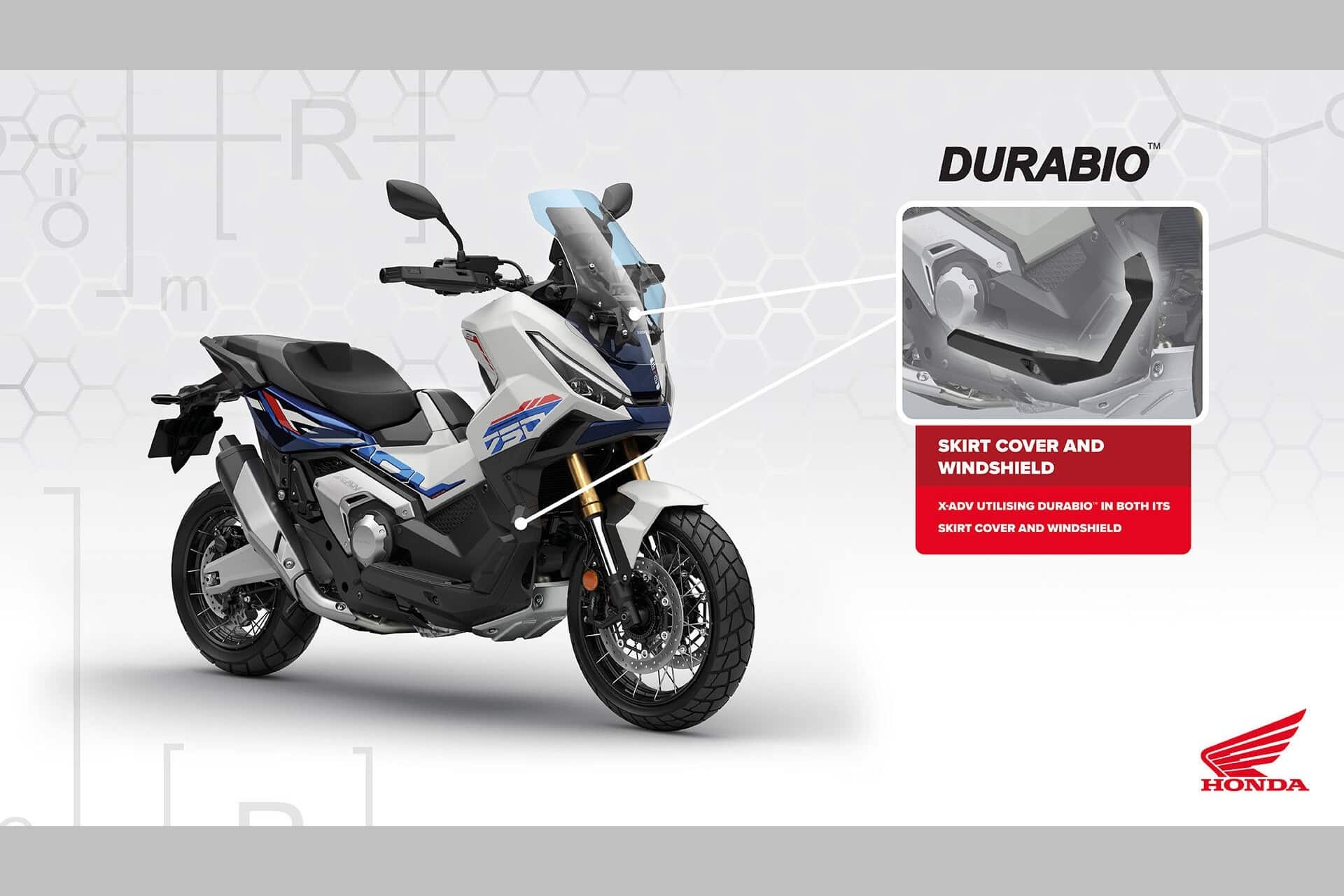
Honda first introduced Durabio in the windscreen of the CRF1100L Africa Twin family, launched in March 2024. This milestone marked the world’s first motorcycle screen made from bio-based engineering plastic, quickly followed by the X-ADV, which incorporated it in its lower fairing and screen. At the same time, it was applied to the handlebar center cover and front side fairing of the Forza 750, integrating perfectly thanks to its high-quality finish.
The NT1100 was the next model to join, with its 2025 update, which included a redesigned front fairing partially made of Durabio, while the current 2025 NC750X adopted the material in its central part, side covers, rear part and screen. The NC750X marked another milestone by becoming the first Honda motorcycle to use colored Durabio on the fairing, in Earth Black and Earth Ivy Ash Green options.
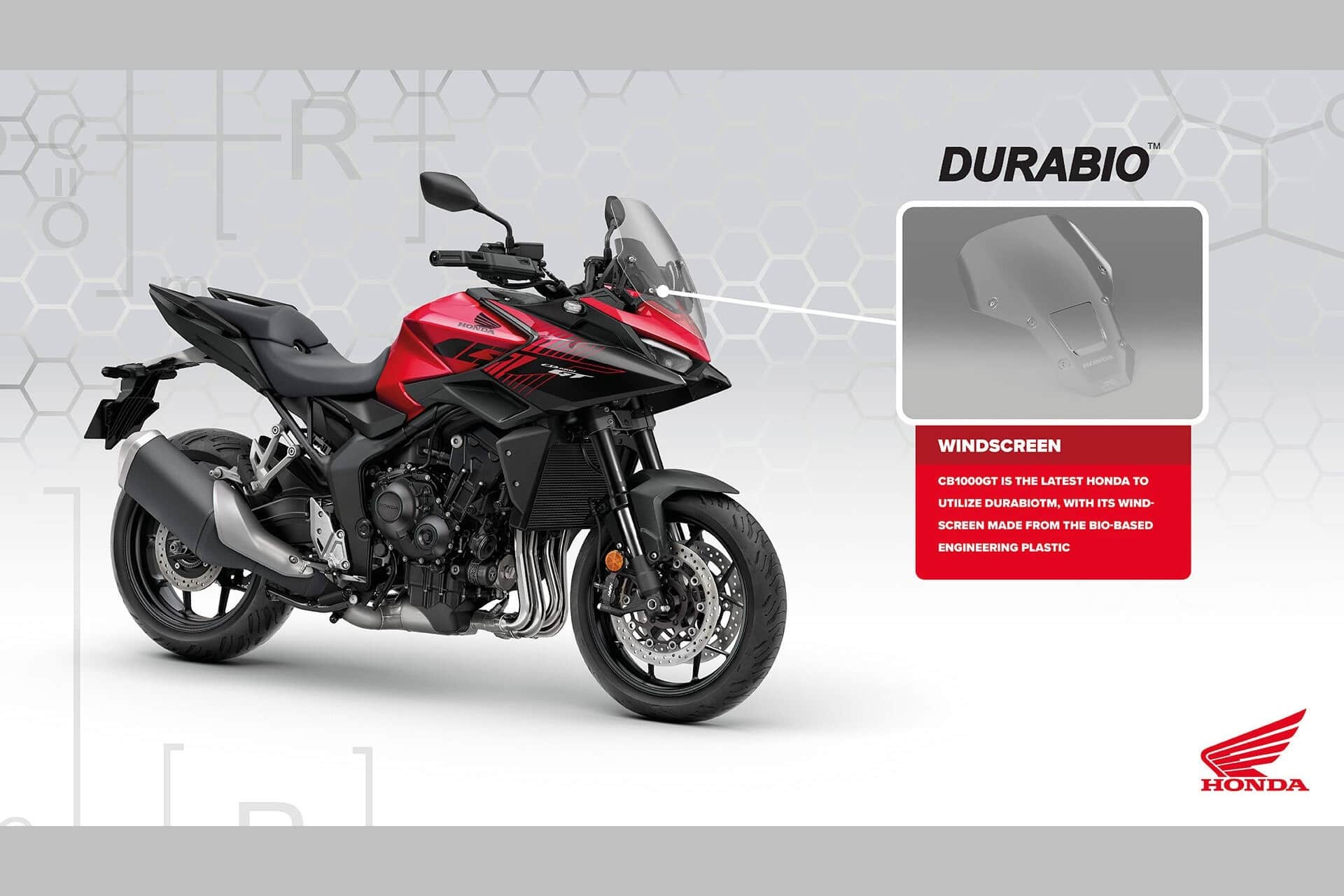
The CB1000GT 2026, presented at EICMA 2025, is the most recent model to incorporate this material, with its screen made of this material. Although Durabio is a key solution to reduce plastic consumption, Honda applies other strategies to move away from the use of newly used raw materials.
Recycled automotive bumpers have been used for years in the automotive division for non-structural parts such as grilles, but thanks to design optimization, this material – previously difficult to apply on motorcycles – has been incorporated into the top box of the 2025 NC750X and X-ADV, while the 2025 Forza 750 uses it in the seat base.
As part of expanding the use of recycled resins, Honda has begun using pre-consumer recycled polypropylene (PP), from waste generated during the manufacturing and molding of automobile and appliance components, which is crushed, compacted, granulated and reused.
Since PP has known properties, it can be adjusted to match the physical characteristics of the virgin material, avoiding the risk of contamination with regulated chemicals. The X-ADV and Forza 750 lead this application, with more than 15 parts made from this material, while the 2026 CB1000F joins in with its rear fender and seat base made of pre-consumer recycled PP.
Driving a circular future through smart use of resources
Honda’s adoption of Durabio and other recycled materials is aligned with its five key resource circulation principles, which seek to move from a linear “extract-manufacture-dispose” model to a circular value chain:

- Business innovation: Create recycling-oriented systems that maximize the use of materials throughout the product life cycle.
- Advanced recycling: Invest in new recycling technologies to improve economic and environmental performance.
- Data traceability: Use digital tools to track CO₂ emissions over the life cycle and improve resource recovery rates.
- Circular design: Design products to facilitate their disassembly and reuse, selecting materials with high recyclability.
- Circular value chain: Collaborate with supply chain partners to ensure consistent sourcing, processing and reuse of recycled materials.
Honda is focused on reducing dependence on finite resources and developing scalable solutions to minimize ecological impact. Currently, around 90% of the raw materials used in new vehicles are extracted from mines.
By adopting renewable and recyclable alternatives like Durabio, Honda is actively working to reduce its CO₂ emissions, conserve resources and mitigate future risks of material shortages.