Some time ago we already talked about the robot that was capable of performing impossible pirouettes on a motorcycle, a true demonstration of how engineering is beginning to play in a league where previously only the instinct, technique and sensitivity of a human pilot ruled. Well, that first sign of where robotics applied to driving was going was just the beginning. The new advance from the team behind the Ultra Mobile Vehicle (UMV) confirms that we are entering a new era: one in which machines not only learn, but interpret the terrain as a professional stunt pilot would.
The UMV has radically expanded its repertoire by being reinforced with millions of physical simulations, a process that allows the platform to improve without the need for continuous physical testing. What is truly surprising is the zero-shot transfer capability, that is, applying what has been learned in a virtual environment in the real world without the need for additional adjustments. This represents a revolution in the way robots learn to move, especially when we talk about dynamic and extreme behaviors.
A robot capable of doing increasingly more complex pirouettes
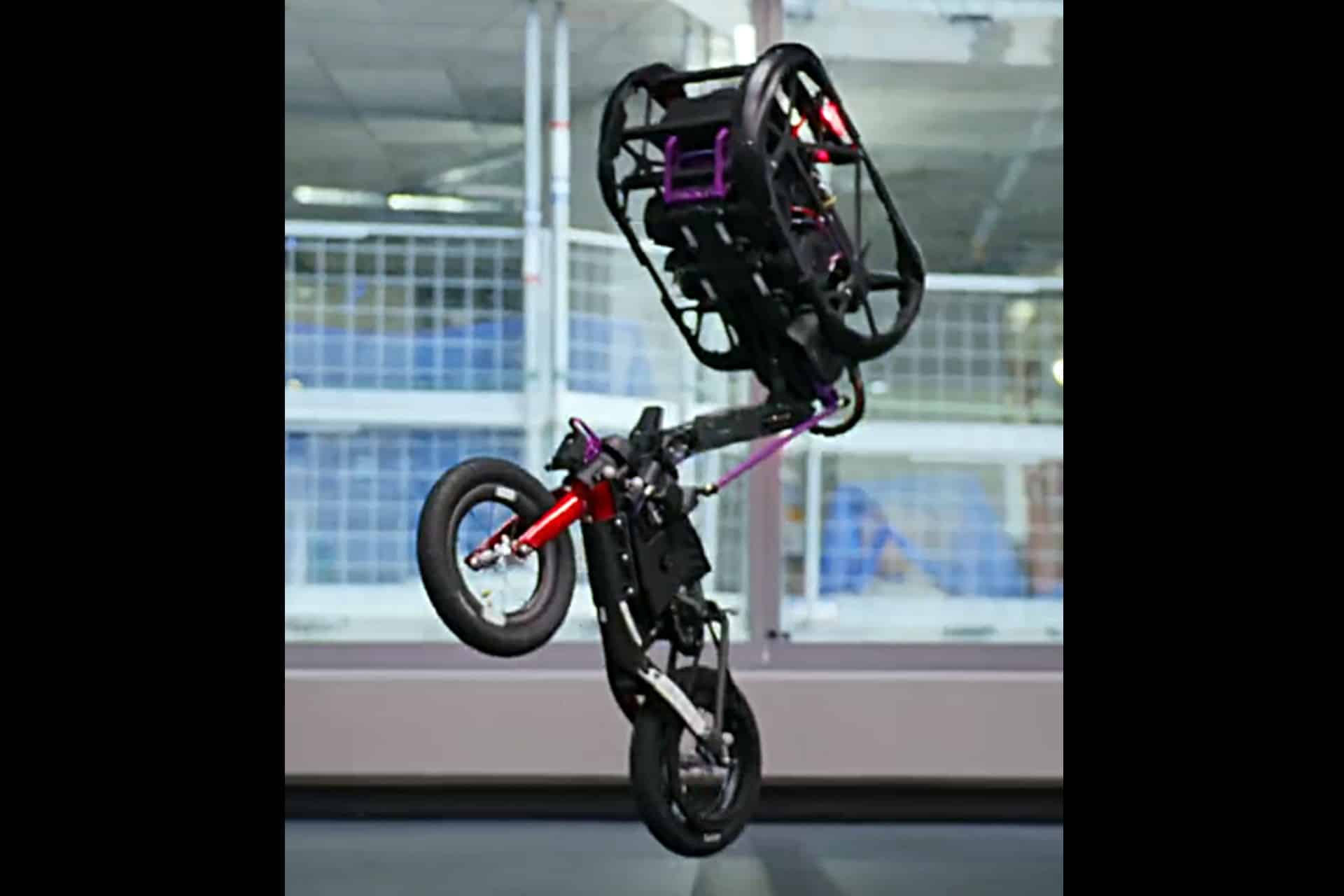
In the recently published reel, the platform demonstrates three key abilities that mark a qualitative leap (and never better said) compared to everything seen so far:
controlled jumps
The UMV not only jumps: it anticipates, adjusts its posture, compensates for body rotation and faces the reception like a pilot who has spent years fine-tuning sensations. Reinforcement learning has allowed the robot to understand how to manage ground energy, mass distribution and the need to anticipate the trajectory based on the obstacle. It’s pure applied physics.
Out-of-plane balance
Until recently, one of the great challenges for robots that operate on two wheels was correcting lateral forces or imbalances generated from unconventional angles. The UMV now manages those vectors as if it had a feel for the terrain, using micro-adjustments and ultra-fast reactions to stay upright. In other words: it no longer just balances; He behaves as if he understood the reason for the balance.
Flips on the flat
Yes, you read correctly: the UMV is capable of doing complete flips without the need for a ramp. It is the most spectacular proof of the power of its control model and the fidelity of the simulations. What for decades has been the exclusive territory of stuntd is now run by an autonomous platform powered by millions of virtual iterations.
The definitive symbiosis between simulation and reality
What really lies behind this advance is not just that a robot can jump or do tricks. It is the way in which it has been achieved. Engineers have used millions of simulations covering every variable imaginable: friction, torque, weight transfer, deformations, inertias, failures and recoveries. From this ocean of data emerges polished, almost perfect behavior.
The key is in the so-called zero-shot transfer: directly applying virtual knowledge to the physical platform without the need to reprogram, recalibrate or “let it make mistakes” on the real ground. This means radically shortening development times and expanding the possibilities for robots that must operate in unpredictable environments.
And what does this mean for the future of mobility?
It may seem like science fiction, but we are facing the foundation of a new generation of autonomous vehicles capable of taking on dynamic challenges that are out of their reach today: rescues in devastated areas, autonomous transportation on irregular roads, exploration in extreme environments… or even new branches of robotic motorcycling, a scenario that a few years ago would have seemed like a joke and that is now beginning to take shape in total seriousness.
And yes, it also opens the door to something inevitable: robots learning tricks, stunts and maneuvers that could completely redefine the relationship between machine and piloting.
What we see today in that brief Instagram reel is just a glimpse of what is to come. The UMV is not simply a robot that moves on two wheels: it is an example of how far engineering can go when combined with the power of autonomous learning. And, above all, it is a very clear warning: the boundaries between pilot and machine are about to blur like never before.
If that first news we told already seemed futuristic to us, this new evolution of the UMV is directly a declaration of intentions for the future of mobile robotics. And he promises that the best—and the craziest—is yet to come.